

Dwell Time: The Hidden SEO Metric Every Digital Marketer Needs to Understand

What is Dwell Time?
Dwell time refers to the time a searcher spends on a webpage after clicking on the search result before returning back to the search engine results page (SERP). As the name suggests, it literally means how long a searcher has dwelt on a webpage.
In SEO, metrics like clicks and impressions are prioritised while dwell time is largely ignored. SEO is all about details and the way to win is to give equal priority to all forms of information that you can obtain about a user’s behaviour. Dwell time is a very powerful indicator of how well your content is sitting with your readers, how informative it is or how interesting or creative (depending upon the intention of the page).
It goes without saying that thinly written articles, poor UX, longer loading times, too many advertisements reduce dwell time.
Why Dwell Time Matters in SEO
dwell time directly signals user satisfaction. If someone is impressed with your content they will stay longer. dwell time is pretty important for SEO because it also signals to search engines exactly how authoritative your page is and how well it is answering a user’s query.
If your pages have a consistently high dwell time, it can improve your rankings because search engines can see that users find your content useful. Conversely, consistently low dwell times will negatively impact your trustworthiness and your rankings may drop taking traffic down with it.
Digital marketers need to keep in mind that it is not enough to get users to visit your page, they need to stay. You will see a lot of websites have taken recourse to writing clickbaity titles that either do not fulfil their promise or are outright irrelevant to the content actually present in the document. This is actually a black hat SEO practice and Google does consider this as spam. Your aim should not be to lure in users with fake promises but to give them what they are looking for.
If a search engine finds out that there is a mismatch between a user’s search intent and the content delivered, it is going to penalise the content. The internet was (at least initially) created to make knowledge more accessible, but in this era of late stage capitalism where knowledge is a commodity, it is diluted and more often than not instrumentalised to further material avarice.
In this capitalist world dwell time matters only for SEO benefits, but if I am to speak to the creator in you, would you not like people to witness what you have created?
How Dwell Time Works
Let us have a look at the user’s journey to understand the mechanics of dwell time and its importance:
- The first thing that happens is a user types a query into a search engine.
- They are presented with the SERP and they pick a webpage that best suits their query (based on the title ofcourse).
- They click on the page link and interact with the content.
- After the interaction, they return to the SERP, either by hitting the back button, closing the tab, or navigating elsewhere.
- The gap between step 3 and step 4 is what is known as dwell time.
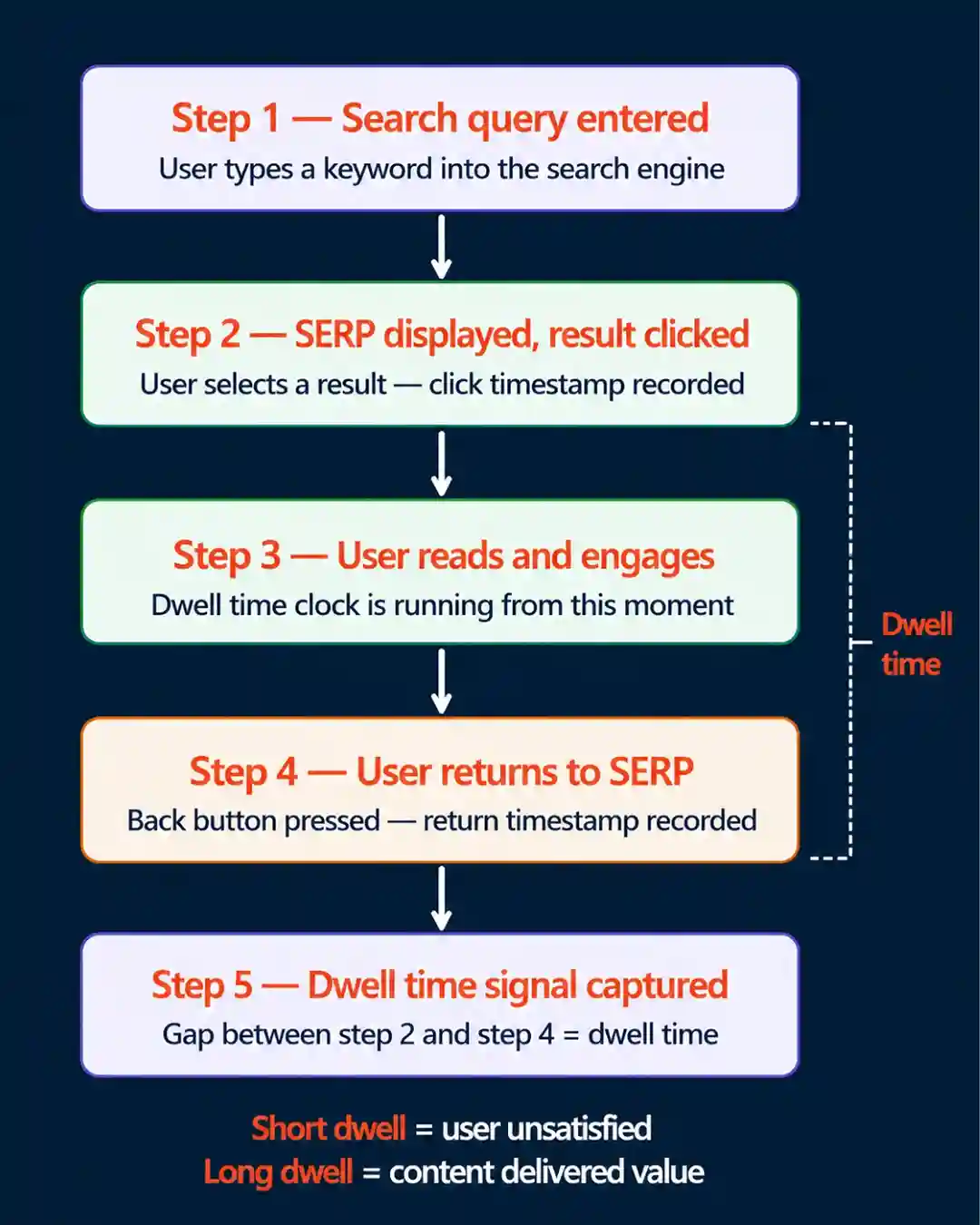
Though dwell time is not a reported metric, search engines can track it. They observe if the user is coming back or if they have left for good. Remember that this function of tracking whether a user returns or not is also performed by cookies but the website administrators have complete access to this data unlike dwell time. dwell time gets recorded irrespective of whether a cookie has been assigned to the user or not and it is a meaningful data point.
There is no universal good or bad dwell time. Some readers take their time, some can go through content exceptionally fast, some contents are of such a nature that they require more time to be spent on it than other types of content. Dwell time varies depending upon the type of content and also the moods, behaviours and characteristic traits of readers.
Dwell Time vs Bounce Rate
It is pretty commonplace to confuse dwell time with bounce rate, let us clarify the difference between the two.
Bounce rate:
- Is a Google Analytics metric that keeps tab of single page sessions i.e how many people are leaving a page without interacting with it further, like clicking on another link or making a purchase or filling a form.
- It does not account for the time a visitor has spent on a page.
- If a visitor spends 20 minutes on a page and then closes it, it would still be recorded as a bounce.
Dwell time:
- Is all about the duration of a user’s stay on a web page
- It measures the time difference between the clicking of the webpage link and the returning of the user back to the SERP.
- It does not record any interactions that a user might have committed while on the page.
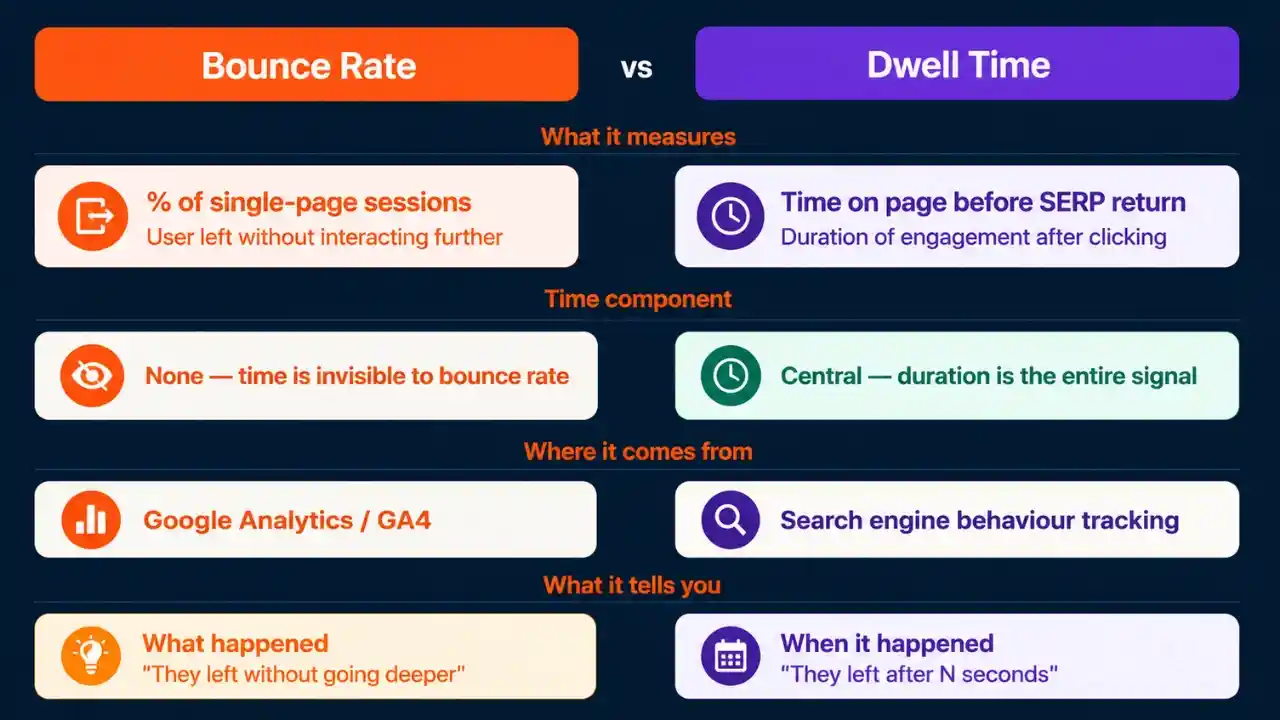
Dwell time is considered to be a more reliable signal than bounce rate for SEO purposes because bounce rate simply tells you what happened while dwell time gives you the duration for which your content could keep the attention of the user. A site may have a 100% bounce rate but that does not automatically mean they are not performing well. A lot of pages do not have any further interaction options.
Factors Affecting Dwell Time
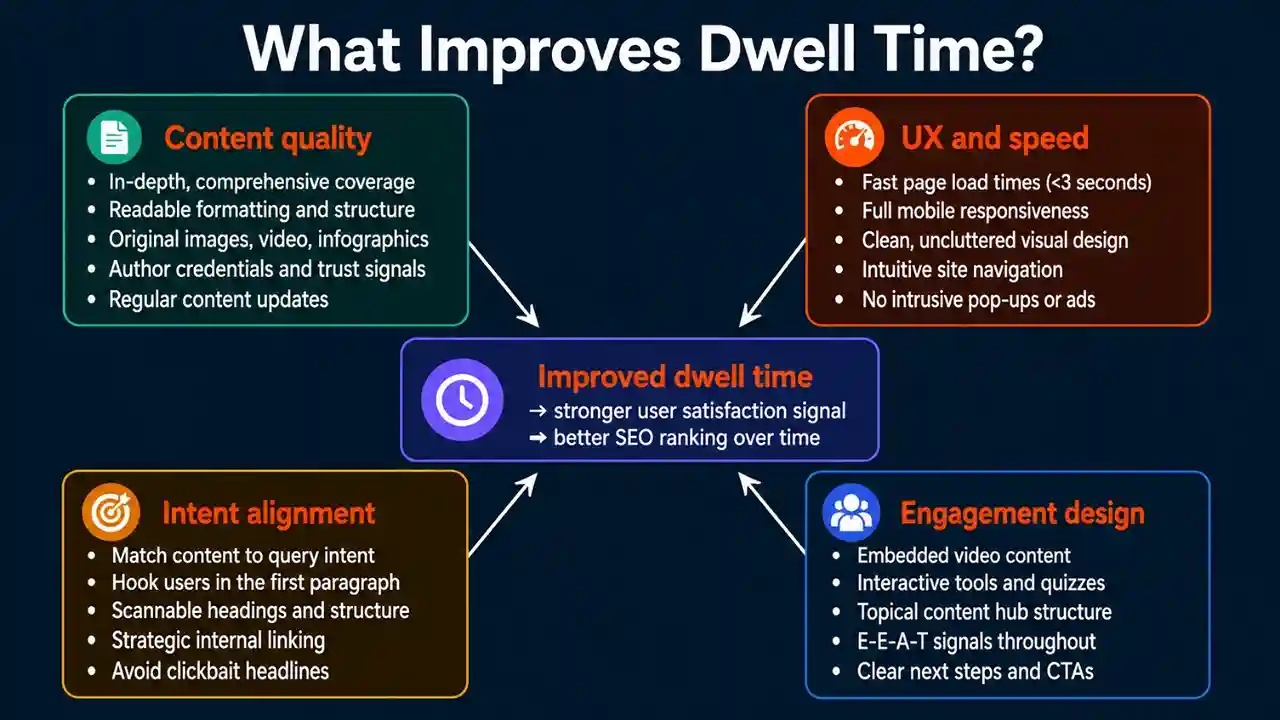
The following are the important factors that greatly affect dwell times of users:
Content-related factors
- Quality and reliability of info
- Whether helpful to the user or not
- Whether it is relevant and matches the intent of the user
- If internal links are present that can aid further discovery
- Whether images and videos are also included.
Technical and UX factors
- Loading speed of the page
- mobile-friendliness
- User friendly design and layout
- Whether there are too many pop ups and other distractions.
- Whether easily navigable
Intent alignment
- Whether the page offers useful info or is just stuffed with unexplained keywords
- Whether the title matches with the content
- Whether the entire article promises to address a defined and explicit problem.
How Content Quality Impacts Dwell Time
It is the quality of content that ultimately holds the user’s attention let us see how you can maximise this quality:
Cover a Topic In-Depth
- A small article that only ever skims the surface of a problem is not going to be able to hold a user’s attention. Make sure whenever you are creating content, make it as detailed as possible.
- Include sub headings that address pain points and offer solutions. If you are writing a problem article that is.
- If you are introducing a concept, cover all the questions that can be possibly raised by a user about it.
- Follow a clearly defined structure and do not forget to make your language easily readable.
Integrate Multimedia
- Most often than not people are more attentive to modes of representation that engage the maximum number of their senses.
- Therefore, do not restrict yourself to plain text only, include videos, images and usable tools.
- This also goes a long way in helping content become more accessible to persons with learning disabilities.
- It is even better if you can include well designed interactable graphics.
Make it Readable
- Make your content jargon free and conversational.
- Use shorter easy to follow sentences
- Illustrate your points using lots of examples’
- Do not write with the help of AI. Trust me people can tell the difference between AI and human written content now.
- Always include bullet points, sub headings and chunk your content, it helps people remember things easily.
Include Trust Signals
- Include author biographies
- Cite all your sources and make sure that your sources are also legit
Common Dwell Time Mistakes
- Clickbait headline – your titles should match the content. Do not lure users in with clickbaits to deceive them. This will not help your site’s reputation.
- Wall-of-text formatting – Do not write blocks of text. Use bullet points and shorter paragraphs instead.
- Slow page load times – Pay attention to your technical SEO. If your site is slowing down for any reason, fix it as soon as you can
- Ignoring mobile users – With Google’s mobilegeddon updates, the prestige of mobile friendly content has increased. If you ignore your site’s mobile friendliness you dwell time will remain low.
- Irrelevant or low-quality visuals – You may feel inclined to add as many images as possible to your content, for better multimodal SEO. However, keep in mind that your article should attain an optimal balance of text and multimedia, generic, low quality and irrelevant photos or even too many photos and infographics may hamper reading experience.
Best Practices to Increase User Engagement
Sound technical SEO is very important for the improvement of dwell time, apart from that make the following fixes and you shall be on fire:
- Cluster Your Content
Instead of creating isolated content, create topical clusters. A topical cluster includes one pillar page which gives a thorough introduction to a topic and several cluster pages which provide a detailed explanation of the sub topics and constituent parts of the main concept. This works wonders in signalling your authority to search engines.
- Update content regularly.
Always make sure that your content is duly updated. Do not leave your content unattended after creating it. Check in, refresh it and offer it some love and life. Do not be like Frankenstein.
- Use storytelling.
Powerful narratives keep users hooked. Even if you are writing about mundane things, turn it into a relatable story. Sometimes, even if people are not interested in your broader topic, they may stay for the charms of your narrative techniques. This is also helpful in creating a brand voice that is unique to only you and your business.
- Personalise the experience
Try and make the experience of a user on your site up close and personal. Suggest them further readings and resources based on their behaviours. Keep them happy and on their toes. This however requires technical knowledge.
- Prioritise E-E-A-T
Google’s concept of Experience, Expertise, Authoritativeness, and Trustworthiness is closely aligned with what keeps users engaged. Content written by credible experts (at this rate actual humans writing their own content is valuable enough), with real-world experience, will always outperform generic AI-generated slop.
- Monitor and iterate
Going back to our Frankenstein point, do not let go of a content after you have created it, keep a close track of how it is performing on the web like a fussy parent and take necessary steps to make it and future content better based on what you have learnt.
Conclusion
Honestly, dwell time is all about making your content interesting enough so that people stay. This is fully in your hands. Your creativity, vision and unique approach towards a problem will keep your readers hooked.
However, it is also true that search engines have developed their own preferences which if followed, gives content the traction they need to become more visible. We are here for that part. Join Gyaner’s digital marketing course to learn all there is to learn about making your online visibility robust. We at Gyaner are dedicated to making digital marketing accessible to as many people as possible, it is a very important skill to possess if you are a business owner or a person looking for a future proof career. Visit our website gyaner.com to learn more about our work and do not forget to keep an eye out for our blog. We regularly post about the recent developments in the digital marketing world.

