

Appear as More Than Just Text on Google: A Guide to Multimodal SEO
The way search engines show results today has changed manifold in the past few years, especially after the AI revolution. Today when you search on Google, especially on your mobile you will see that answers will be provided to you in various formats. You will inevitably see an AI overview and for some search results you will also see a row of images, short video clips and sometimes even a voice-friendly answer (primarily when you also ask a question using your voice). This is the result of a shift in how search engines work and has given rise to a new field of SEO called Multimodal SEO.
What Is Multimodal SEO?
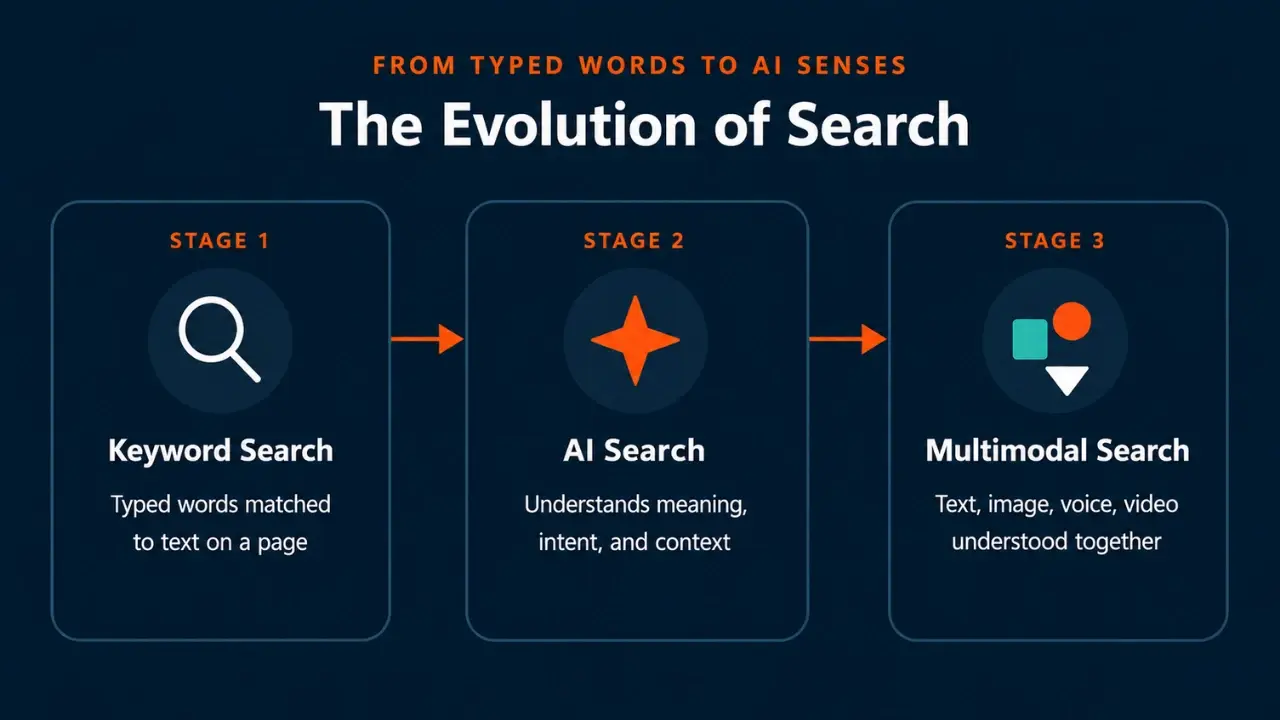
Multimodal SEO refers to the process of optimizing your content in such a way that it can be understood and ranked by search engines across multiple formats and not just plain text. Digital marketing content creators can no longer afford to pay attention only to keywords on a page, they need to also figure out how images, videos, audios and written content collaborate to best answer a user’s query.
The term “multimodal” simply means “many modes” or “many formats.” In the context of AI Search, it refers to search engines that can process and combine different types of input and output, such as text, pictures, voice queries, and video, all in a single interaction and for the purpose of holistically answering a user’s query.
Earlier, traditional SEO was all about matching keywords typed into the search box and showing pages that mentioned those keywords. With the advancement of Multimodal AI models, Google developed the capacity to understand images, hear audio and read video transcripts in addition to texts. Tools like Google Lens, voice assistants, and AI chatbots with browsing capabilities are examples of this shift.
How Multimodal Search Works
To understand how multimodal search works, let us see what happens behind the scenes when a person performs an AI powered search.
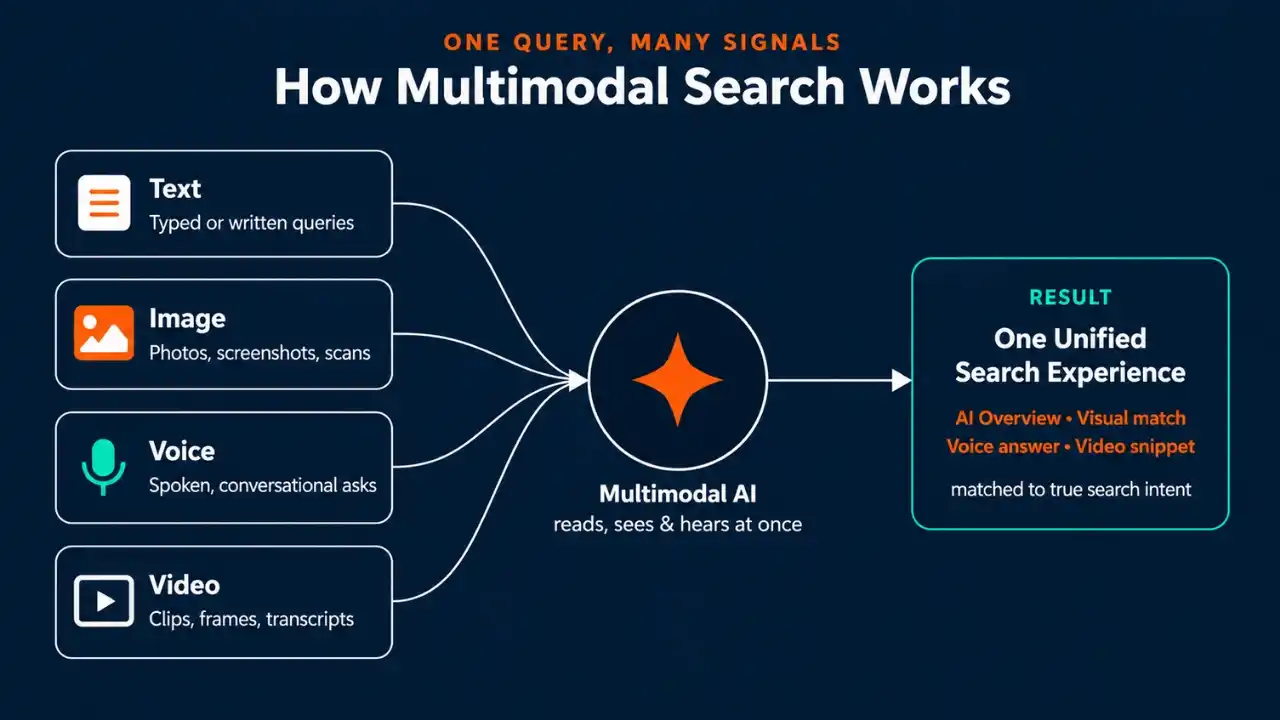
The models upon which modern search systems are built allows several types of data to be processed natively as opposed to individually. Say you upload a picture on AI chat, ask it a question about the image, the system will not treat the text you have typed and the image you have uploaded separately, the meanings of both will be merged together and contextualised to understand exactly what the user wants. This combined understanding is what makes the response feel more natural and accurate than older keyword-matching systems.
Here is a simplified breakdown of how each input type contributes:
- Text anchors most searches and helps AI understand topics, entities, and the relationships that exist between ideas.
- Images are analyzed using computer vision, which can identify objects, colors, settings, and even style or mood.
- Audio and voice queries are converted into natural language and then interpreted in the form of a conversation, and this happens often as full questions rather than short keyword phrases.
- Video is broken down into visual frames, captions, and transcripts, allowing AI to understand both what is shown and what is said.
Today, a search result is a single, combined understanding of a user’s intention. A search engine no longer needs the exact words “red running shoes” to find a product if it can recognize the shoe color, style, and category directly from an image. This is the core idea behind Multimodal Search
Why Multimodal SEO Matters
In order to be more convenient to humans, search engines have developed myriad ways to understand the meaning and intentions of searchers. Multimodal SEO is a step toward a holistic presentation of results.
Instead of typing, people are increasingly talking to voice assistants, clicking pictures of things they want to know more about. Reports say that search tools alone now handle billions of searches every month, with a meaningful share tied directly to shopping and product discovery.
We need to remember that voice queries are more often than not longer and conversational, this has effectively changed how content needs to be written
AI-generated overviews are capable of compressing multiple research documents into a single, synthesized answer. Therefore brands need to be the source that AI trusts and consequently cites, simply ranking on SERPs is not enough.
For marketers it is therefore extremely important to optimise for all modes of presentation of results: voice, video, image, text. Brands that will successfully lean into various formats will see greater engagement rates and be more trusted by search engines.
Key Elements of Multimodal SEO
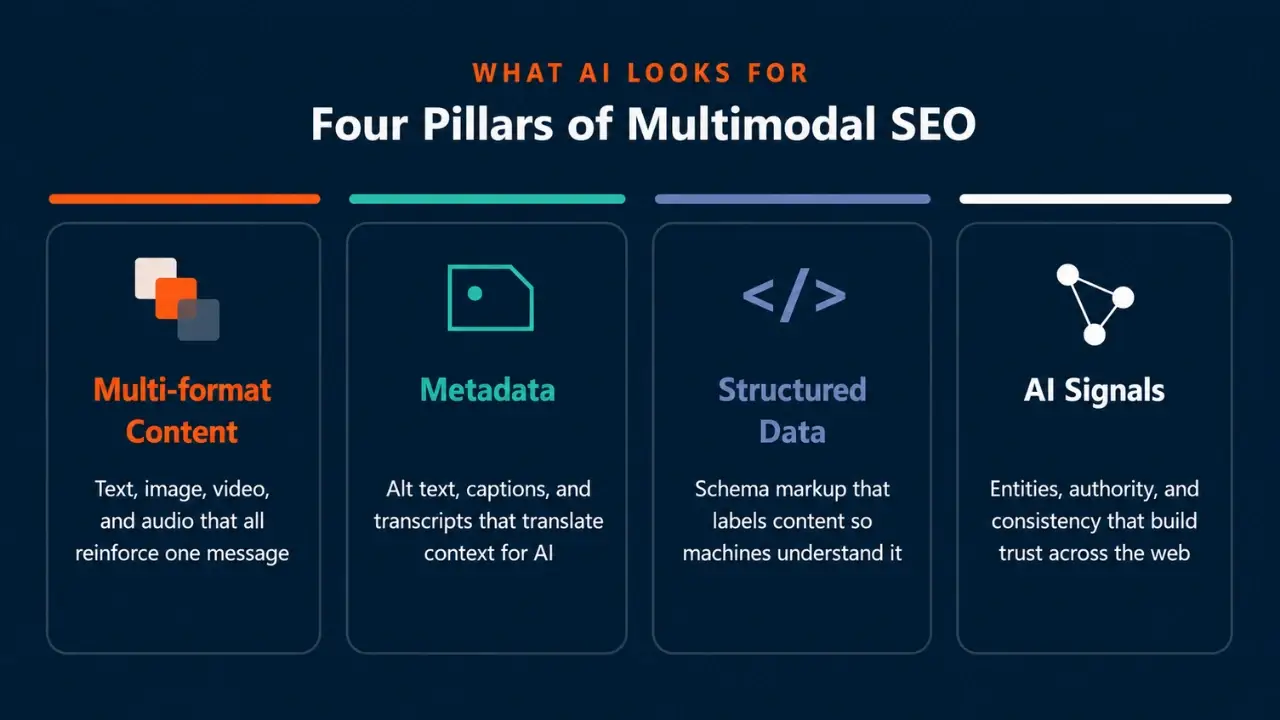
A sound Multimodal SEO strategy rests on the following building blocks:
- Multi-format Content: written articles, product images, short videos, podcasts, and infographics that all communicate, corroborate and reinforce the same core message in different ways.
- Metadata: Refers to the descriptive alt text for images, filenames, video captions, and transcripts. Metadata helps AI systems read content that is not entirely text-based. See AI, cannot actually see in the human sense of the word, it can only process numbers and texts. So an image you upload is only as good as the code and text behind it.
- Structured Data: I cannot emphasise enough on the importance of having structured data. It gives search engines machine-readable labels for products, reviews, recipes, FAQs, and videos. Some visual rich-result formats have become less prominent and some have deprecated over time; the underlying structured data is still helpful for systems in understanding content.
- AI signals: AI systems are increasingly looking at who is saying something and how consistently a brand or an author appears across the web
Building a Multimodal SEO Strategy
Firstly, you need to see how your website has been doing so far, start with a site wide audit. Review how your pages are appearing on results, in voice assistant queries across image and video searches. You may take the following strategic steps to improve your multimodalness…
- Review your existing content to ensure that it answers real questions in a clear, conversational way that matches natural language search intent.
- Audit images for quality, descriptive filenames, and alt text,
- Submit image sitemaps so search engines can find them easily.
- Create short, focused videos that answer common questions, complete with captions and video schema markup.
- Write conversationally and use abundant long-tailed keywords.
- Keep your pages fast and mobile-friendly, search engines heavily penalise slow-loading pages which in turn will hurt both image and video discoverability.
AI’s Role in Multimodal SEO
Artificial intelligence and natural language processing systems have allowed search engines to understand the semantic content of what they post. We have come a long way from keyword matching, Generative engines today have the capability to read thousands of documents and construct the most relevant and helpful answer for queries.
AI SEO involves Answer Engine Optimisation and Generative Engine Optimisation all of which makes your content more usable by AI. The more visible you are to AI the more multimodal your content is going to be. You will automatically have greater visibility across image and video searches.
Multimodal SEO Best Practices
- Write alt text that accurately describes the scene and context of an image, instead of adding a generic label. This helps because AI models match images to complex, descriptive queries.
- Always keep image files compressed and named so that pages load quickly on across devices (especially on mobile devices)
- Add transcripts and captions to every video you upload and use video schema markup so that platforms may easily index your spoken content.
- Structure your written content with clear headings (H1, H2) and include direct answers near the top, this format tends to perform well on AI overviews and chats.
- Always use author and organization schema, and keep author bios and credentials visible.
- Maintain strong Core Web Vitals and accessibility standards. It goes without saying, fast, accessible pages continue to perform well with both human users and machines.
Challenges of Multimodal SEO
Multimodal SEO is not without its difficulties. The most immediate challenge is simply effort: optimizing across four or more formats takes considerably more work than writing text alone. Transcripts, schema, and well-prepared media require time, tools, and often new skills that many teams do not yet have in place.
Measurement is another hurdle. A voice answer or an AI summary can fully resolve a user’s question without ever generating a click, which makes traditional traffic-based metrics incomplete. Marketers increasingly need to track impressions, citations in AI answers, and brand mentions, rather than relying solely on click-through rates.
There is also a moving-target problem. The way AI systems parse and prioritize different formats keeps changing, so a tactic that works well today may matter less in a few months. The most reliable response to this uncertainty is to focus on genuinely clear, accurate, and well-structured content, since that tends to remain valuable to both machines and people even as specific algorithms shift.
Conclusion
Multimodal SEO requires expertise and technical knowledge more than any other forms of SEO. However, today with the correct tools it becomes easy to perform such a function such as this. To help you out with your SEO needs Gyaner has designed a cutting edge SEO course, which, if you complete will equip you with all the skills required to build a perfectly SEO optimised website from scratch. To find out who we are and what it is that we do visit gyaner.com you can also book a free classroom session if you so wish.

