

Why Your Best Blog Posts Aren’t Ranking in 2026: Fix it by Creating Topic Clusters

Google and most search engines have a framework that helps them figure out whether or not an article is credible and of good quality. This framework is referred to as E-E-A-T, (also called double E-A-T), which stands for:
- Experience
- Expertise
- Authoritativeness
- Trustworthiness
One of the strongest signals that a website demonstrates all four, lies in its content structuring capabilities and mechanisms. Topic Clustering is one of the most important ways of achieving a stellar content structure. In this blog we are going to break down what Topic Clustering is and how you can create it. This article shall be helpful for both beginners and those who have already started publishing written content on their website.
Table of Contents
ToggleWhat is a Topic Cluster?
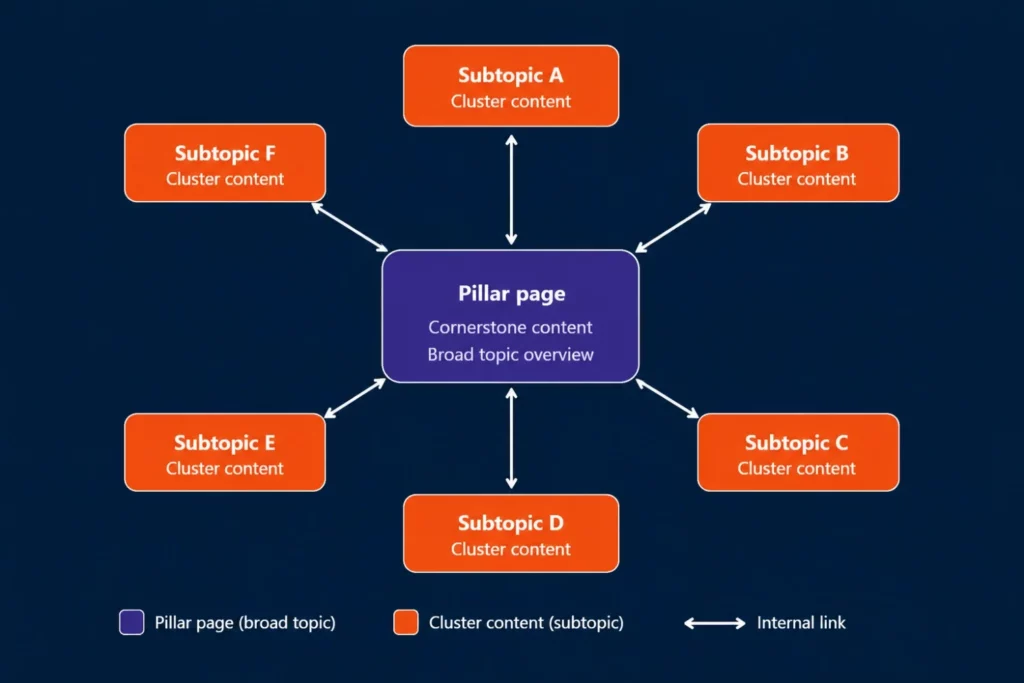
A topic cluster refers to a set of interlinked web pages that are built around a single broad topic. The broad topic, say for instance, “soils of India”, is referred to as the pillar page, while sub topics built around it, say “alluvial soil”, “laterite soil” “red soil”, etc, are referred to as the cluster pages. The pillar page article is usually longer, and includes a brief explanation of almost all that is pertinent to the topic, but it is not exhaustive. Each part of the longer pillar page article is described in detail in the cluster pages.
The Key Components of a Topic Cluster
A Topic Cluster has three Components:
- The pillar page
- The cluster pages
The internal links (this runs in both directions, i.e., pillar page links to cluster pages and cluster pages link to pillar page)
Topic Clustering and its Effect on SEO
Google’s Hummingbird update in 2013 is considered by many SEO professionals as Google’s switch from keyword to intent matching. This update was primarily made by Google to attend to highly specific questions posed by users. Earlier users used to search by keywords, but there was a rapid shift in this behaviour and they expected search engines to answer more complex questions. Now, the meaning that your content conveys has more value than the keywords it contains.
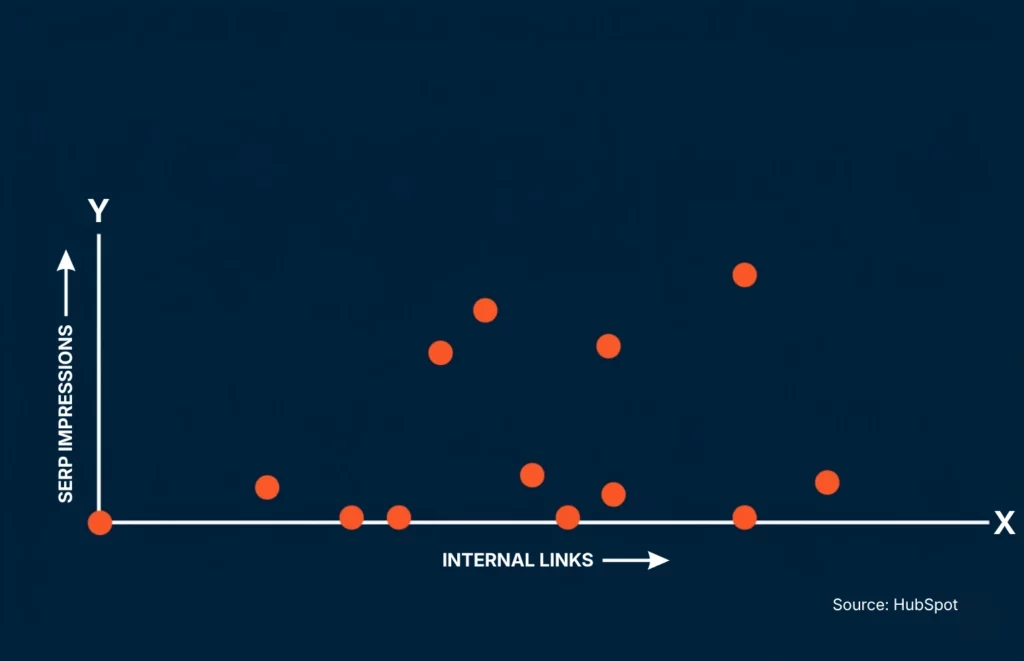
In view of this update, Anum Hussain and Cambria Davies, who worked with Hubspot launched various topic cluster experiments in 2016. They found out that having topical clusters helped pages rank higher on SERPs. There was no looking back after this. Gradually, topic clustering became immensely popular among website content administrators and writers.
Why Does Topic Clustering Work Magic for SEO?
- If your website has topic clusters, it demonstrates to search engines that you have in-depth knowledge of the topics you are writing about. It signals authority and experience.
- Since interlinking is an important aspect of topic clustering, it increases visibility sitewide. (Think about this, you are beginning to research on a topic you know nothing about, you land on the pillar page, you get an overview and also links to cluster pages that exhaustively define the topic’s constituent sub-topics, your curiosity will be piqued and you will most likely click on the links, increasing the site’s visibility and scroll-time)
- While pillar pages rank for high volume, and broad head terms, cluster pages rank well for long-tailed keywords.
Note: Long-tailed keywords are all the rage now, because they are increasingly being used by users to have complex and highly specific queries answers.
What is Cornerstone Content and How is it Different From a Pillar Page?
Cornerstone Content
Cornerstone content refers to the most representative and foundational content of your website. This content tells your readers what your brand is all about. This is a sort of introduction to who you are and what you do as a brand. Cornerstone content does not necessarily have to exist within a cluster. This was popularised by the Yoast plugin for WordPress.
Pillar Page
A pillar page consists of an authoritative, long form content that demonstrates your knowledge of a broad topic. A pillar page is linked to multiple cluster pages. Unlike a dated blog path it lives in a clean evergreen URL.
Note: Every pillar page should ideally be a cornerstone content, but it is not necessary for every cornerstone content to be a pillar page.
Features of a Good Pillar Page
- Targets a broad and high volume keyword.
- Talks about as many aspects of the topic as possible.
- It is well-structured and provides readers an at-a-glance experience.
- It links to every cluster page.
- The content is designed as a page and not as a blog. Regular updates are made to it.
A Comparative Chart of Pillar Page and Cornerstone Content
| Cornerstone Article | Pillar Page |
Origin | Yoast / content strategy | HubSpot / SEO architecture |
Defined by | Editorial choice | Structural role in a cluster |
Needs cluster pages? | No | Yes, without them it’s just a long article |
Primary goal | Brand authority, user value | SEO ranking, link distribution, greater comprehension by generative models |
Format | Usually a long blog post | Often a dedicated page or hub |
Building a Topic Cluster Step-by-Step
Step 1 – Choose a topic that is broad enough to have several sub-topics. For example, “Basics of SEO”, “Social Media Marketing” and so on.
Step 2 – Identify what your pillar page should be. Cover the full topic and add links to wherever you think there is a possibility for further research by the readers.
Step 3 – Identify your subtopics using tools like Semrush, Ahrefs and Google’s “people also ask”. These tools will basically give you an idea of what people are currently looking up on the search engines.
Step 4 – Create the cluster pages on each subtopic or areas in your pillar page that need deeper research.
Step 5 – Build a robust interlinking strategy. All cluster pages should link to the pillar page and the pillar page must always contain the links to the sub-topics.
Step 6 – Data and knowledge is ever-increasing, therefore you must keep refreshing your pillar page and your cluster pages with new information and updates.
Conclusion
What content writers need to be most aware of right now is that they must not take any short cuts like keyword stuffing and automatic AI writing. Try to not use AI at all while writing. AI is trained on existing knowledge and biases that go with it. Your overdependence on AI will leave no room for new knowledge to be created. Google does not reward regurgitated content. It looks for originality and authoritative originality at that. Creating topic clusters is a time taking process and it requires deep research and a true enthusiasm to know all that there is to know and then come up with your own sets of ideas.
If you need help with structuring your website in such a way that it ticks all the SEO best practices checklist then consider enrolling for our digital marketing course in Hyderabad, where we teach the A-Z of creating a robust and successful online presence for your business.
As for creative thinking, we leave that to you, and with faith!
FAQs
Not exactly. A cornerstone article is defined by its importance to your brand, its editorial. A pillar page is defined by its structural role, it anchors a topic cluster with two-way internal links to cluster pages. Every pillar page should be cornerstone content, but not every cornerstone article is a pillar page.
There's no fixed number, but a functional cluster typically has between 5 and 15 cluster pages. Each subtopic your pillar page mentions should ideally have its own dedicated cluster page linking back to it.
Technically yes, but it's not ideal. Pillar pages work best as standalone, evergreen pages with clean URLs (e.g. /seo-basics-guide) and not dated blog paths. Unlike blog posts, they should be updated regularly rather than treated as one-time publications.
Yes. Generative AI models (like Google's AI Overviews) favour content that demonstrates clear topical authority and depth which is what a well-built topic cluster signals. Structured, interlinked content is easier for both search engines and AI models to understand,cite and build on.
Always start with the pillar page. Cluster pages are anchored to it. Publishing cluster pages without a pillar leaves them structurally orphaned. Build the pillar first, then create cluster pages one subtopic at a time.

