

How Google Started to Think Like a Human: A History of Pre-AI Google Algorithm Updates (2011-2015)

The aim of this blog is to give you a new perspective on older Google algorithm changes. This is the first article in a series of two articles. Here we shall talk about how Google slowly started being more discerning about quality and accessibility. This blog is designed to not only summarise the features of major algorithm updates but to also draw your attention to the intentions of Google and its ambivalences. This form of knowledge is important because it gives us an idea about the origin of a process that is widely talked about but not critically explored: SEO.
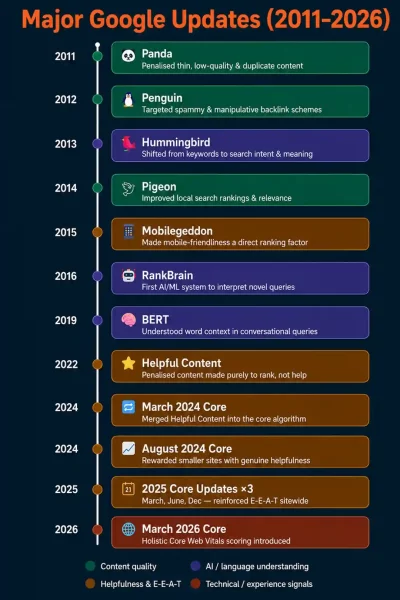
Table of Contents
TogglePanda Update – 2011
On 24th February 2011, Google published a blog announcing that they have launched a massive algorithmic change which would ostensibly impact 11.8% of their queries. This was Google’s first ever initiative to make the internet a more meaningful place for users, because people had been using unfair means simply to rank higher. Meaning making had become secondary to earning ranks. The following are the objectives of the update:
Aims of the Panda Update
Reducing rankings of:
- sites that are poor in quality
- sites that provide little to no value to users.
- sites that blatantly plagiarise the content of other websites.
Boosting the rankings of:
- High quality sites that add real value
- Sites with original content that offer in-depth, critical and “thoughtful” understanding of topics.
Google Addresses Creator Concerns over Panda
What Google firstly does is ask creators to not tear their hair over the updates, because it has already introduced more than 500 updates after the Panda Update, all designed to guarantee better user experience. Now, this is something website administrators and creators need to keep in mind:
- Focus on delivering intelligible and helpful content. Write and create things that you know you would like to read and see.
- Do not try to butter up Google’s algorithms using black-hat SEO tricks.
Here is a peek into the mind of Google, in terms of what questions it asks, when it creates algorithms that can effectively decipher which content are of high quality and which are shallow:
- Is the information provided trustworthy and verifiable?
- Has it been written by someone who is an expert on the topic?
- Is the content redundant, repetitive, stylistically incorrect, and has typos?
- Is the primary intention of the article to rank higher or to address genuine user questions?
- Is the article prejudiced or does it offer a balanced argument?
- Does the article point out things that may not be immediately obvious, thus offering newer insights.
- Is the article shareable and recommendable?
- Is the article hastily written with little to no attention given to details and visuals?
Most Importantly
- Can the article be expected to appear in an encyclopaedic entry or be published in a book?
Note: For the exhaustive list of questions, please refer to the official Google Search Central Blog.
Penguin Update of 2012
On Tuesday, April 24, 2012 Google announced an update which was aimed at:
- reducing black-hat SEO practices. (keyword stuffing, irrelevant linking. Read the section titled “Spam detection system” in our blog on Google’s indexing algorithms)
- Reducing overall webspam
Interestingly, in the blog, the term “penguin” has not been used, it was only later in 2016, that Google publicly mentioned that Penguin has become a part of Google’s core algorithm. Penguin is essentially one of the many signals
The 2012 blog is a rather interesting read, for, it might change the way you view SEO right now. Here are certain things, I would like to draw your attention to:
To Optimise or Not to Optimise?
The article begins by reiterating that SEO can make pages more crawlable and more discoverable. However, it ends with the line,
“We want people doing ethical search engine optimization (or even no search engine optimization at all) so they can focus on creating amazing, compelling web sites”
So, which is it, does Google want you to optimise or not? Now, what we are witnessing here is a conundrum. Google is not a person or a group of people with critical thinking skills. There are certain signals that help Google classify whether or not an article contains useful information. Unfortunately, these signals can be manipulated. The greatest example is “keyword stuffing”, a page may try to achieve ranking by simply listing words that are popular. This is something Google does not want you to do, hence the Panda and the Penguin updates.
However, it is also true that your page might not rank despite producing highly valuable, original and thoughtful content. Why is that? Because it has not been structured in a way that renders the page easily crawlable. Structuring your article in a prescribed way becomes necessary when a machine, which is programmed to homogeneously and consistently privilege a certain structure over others, reads it. It is the duty of the developers of such a programme to let its users know what kind of structure is made visible and what is excluded.
Therefore you should:
- Try to understand the structure that is preferred, like AEO and GEO, topic clustering, schema markup, simplified language, pictorial and infographic representation.
- Do not try to manipulate the algorithm using spammy methods. Be ethical in your SEO practice.
Hummingbird Update 2014
Google did not publish anything officially to explain what Hummingbird is. Googlers tried to understand it themselves. What’s in the name you ask? Do you know how fast a hummingbird flaps its wings? Around 50 to 80 times per second. Hummingbird update was made with the view to make Google’s core algorithm fast and accurate. What we know today of hummingbird comes from Google’s former software engineer Matt Cutts. Let’s find out what Hummingbird is all about.
Features of the Hummingbird Update
- Hummingbird is not Google’s core algorithm update like Panda and Penguin. It is a revision of the former core updates. Matt Cutts explains it as a rewriting of the core updates.
- The primary aim of the update was to better match natural language user queries with the relevant webpages.
- Earlier, Google used to try and match exact words that the user typed in the search bar with words on webpages (much like a simple “find” function we have in word processing apps). The Hummingbird updates allowed Google to understand the meaning of the user’s query.
- Query Expansion – People look for the same things with different words and expressions. Hummingbird update enabled Google to understand the multiple ways in which an user may look for something.
- Hummingbird allows Google’s algorithms to remove words that are not relevant to the user’s context from mobile voice search queries. For instance you may use words like “please”, “my dear” and so on while asking Google something, these words are not relevant to what you are looking for.
Pigeon Update – 2014
Officially, Google has never announced that there has been any changes to its algorithm termed the “pigeon update”. It was Search Engine Land who noticed along with other Googlers that local search result experience has changed, and they termed it the Pigeon update. It is likely that this does not refer to a single update, rather a series of updates affecting the local search experience. The update is believed to have launched around July 24, 2014.
Features of the Pigeon Update
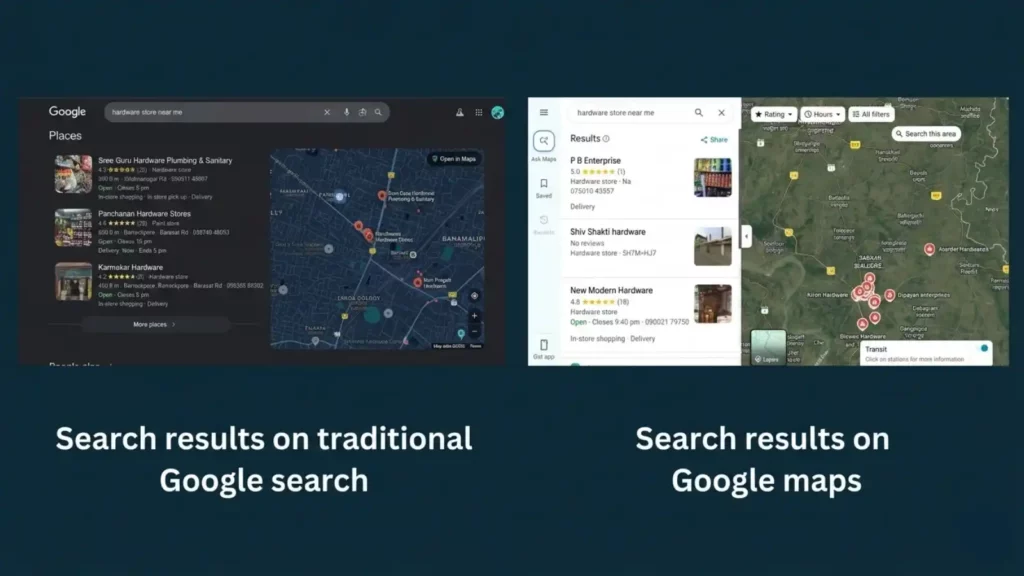
- Increased the visibility of local businesses that have organic traffic in traditional search. Earlier this kind of visibility was only granted through Google maps.
- Irrespective of the size of the business, its location would turn up high on search results, provided user intention matched.
- The pigeon update was also like all other updates a revision and augmentation of search signals.
The Visible SERP Changes
- Local businesses “near me” showed up on traditional searches, in a format that is similar to how they showed up on Google maps. They were displayed on the SERP complete with their location on the map, rating, distance from your current location, opening and closing times and a direct option to call the business.
- Earlier, when one searched for a local business near them on Google, the SERP that was returned was filled with the list of businesses, now we see three businesses listed on top, based on nearness to your specific location and its rating.
Mobilegeddon – 2015
Barry Schwartz of Search Engine Land termed Google’s algorithm change that facilitated mobile friendly experience as Mobilegeddon. This was Google’s attempt to become mobile-first. We shall not go into the history of exactly what happened when it was rolling out this massive algorithmic change. We shall discuss only the features and look at some additional conversation around the update. .
Features of Mobilegeddon
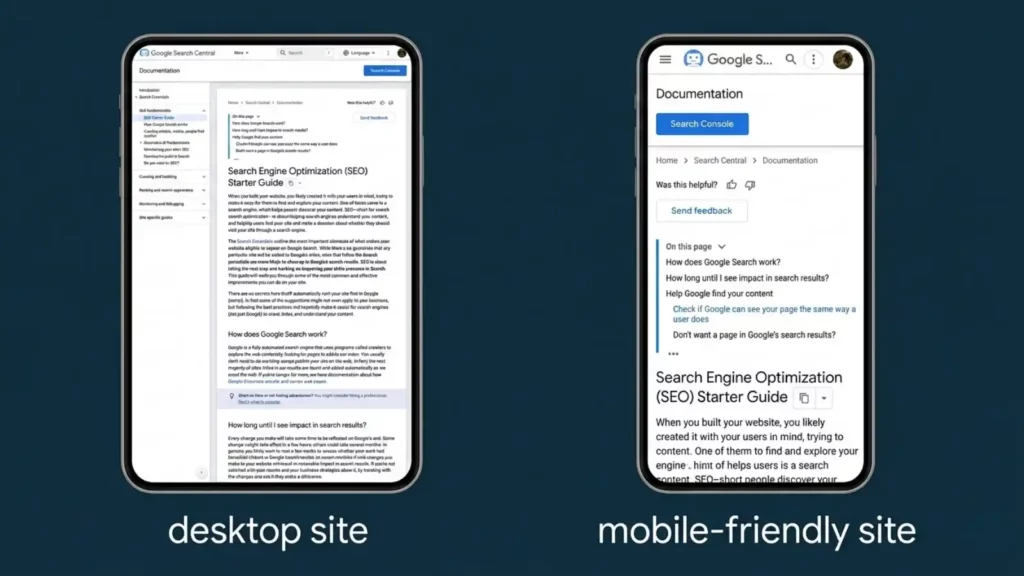
- Established what the difference is between a mobile-friendly and a non mobile friendly site.
- Mobile-friendly sites began to outrank non-mobile friendly sites
Other Conversation Around The Mobilegeddon Update
If you’ve read this far, you have probably noticed that Google does not really like to let its users know about its major algorithm updates. It is SEO enthusiasts who figure out changes in Google’s behaviour, and name the collection of changes as a major update. Though the name Mobilegeddon was given by Search Engine Land, Google actually informed its users beforehand that a major change is going to happen.
Search Engine Journal has described Mobilegeddon as a “cultural shift” rather than an algorithmic shift, and that I think is very interesting wording. It is Google’s step towards accessibility and improved user experience. If we think of googlers in India, a large number of them access the internet through their mobile phones, which was made more readily available at low prices following the digital India drive. For a country like ours, Mobilegeddon ensured equality of experience irrespective of what gadgets a person used to access the internet.
Conclusion
Panda, Penguin and Pigeon updates ensured that quality content was served to googlers, Hummingbird update was Google’s first ever step to understanding natural language queries better and Mobilegeddon ensured mobile-first search experience for googlers. The reason why we should study these updates closely, is to have a better grasp of how user behaviour has shaped Google algorithms and also to predict what algorithmic changes can happen later. This form of study can help students of digital marketing especially to evaluate the importance of understanding consumer behaviour.
Stay tuned for the next part of our article, where we discuss the post-AI algorithmic changes of Google. Meanwhile, if you wish to brush up on your basic AI SEO skills, pay us a visit at gyaner.com. We are located in Hyderabad, feel free to drop in!
FAQs
The Panda Update was launched in 2011 to reduce rankings of low-quality, thin, plagiarised, or unhelpful content and reward original, valuable content.
The Penguin Update focused on reducing black-hat SEO practices such as keyword stuffing, irrelevant linking, and webspam.
Hummingbird helped Google understand the meaning behind natural language queries instead of only matching exact keywords.
The Pigeon Update improved local search results by giving more visibility to businesses relevant to a user’s location and search intent.
Mobilegeddon made mobile-friendliness a ranking factor, allowing mobile-friendly websites to perform better than non-mobile-friendly sites.

