

LLM SEO: How to Optimize Content for AI Search, AI Overviews, and Large Language Models
What is LLM SEO?
LLM SEO refers to the practice of optimising your content in such a way that large language models, AI search engines and generative engines can understand, trust and cite your content.
LLM SEO is different from traditional SEO primarily in their intentions. The aim of traditional SEO is to make your page rank high on Search Engine Results Pages (SERPs). The aim of LLM SEO is this plus much more. With LLM SEO you can rank not only on search engine results but also get featured on AI chats. Rankings, clicks and traffic still matter here.
Users now ask longer and more complex and specific questions to search engines and AI chats. LLM SEO is all about structuring your content in such a way that these specific queries of people can be answered. We shall look into the ways of doing this later on in the article, first let us try and understand the mechanics of LLMs itself.
How LLMs Find and Understand Content
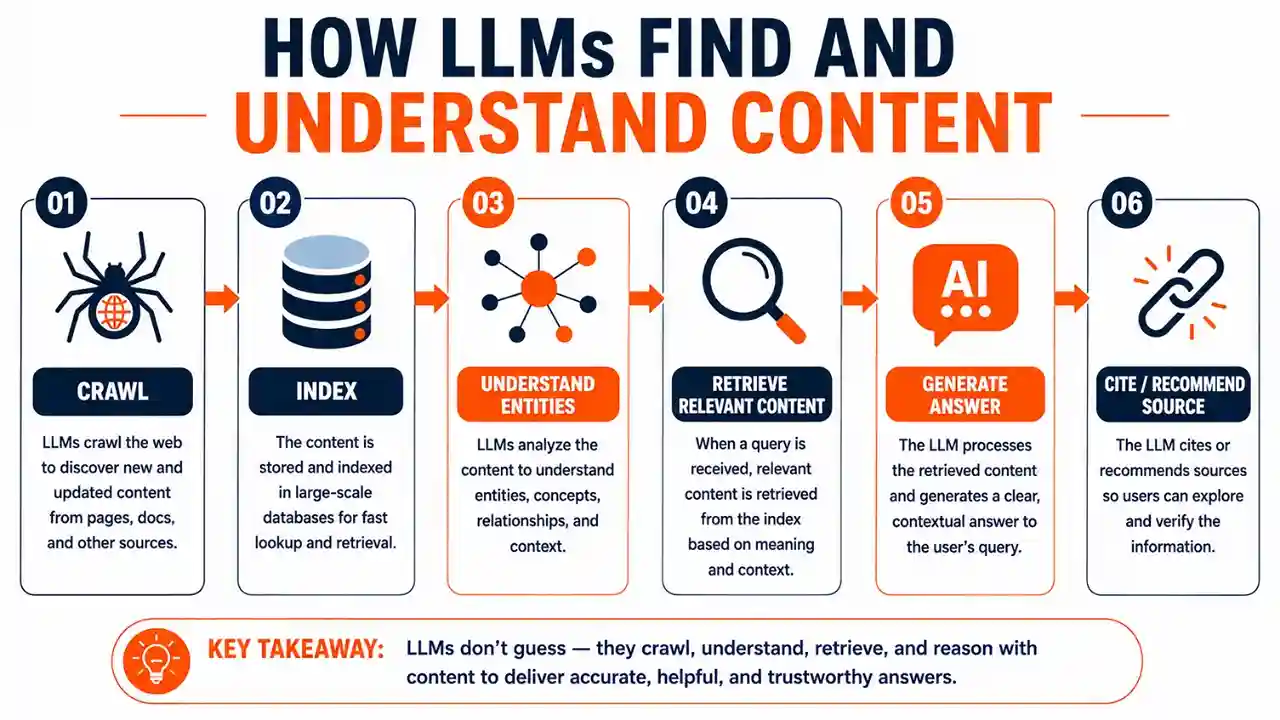
Large Language Models or LLMs do not comprehend websites like humans do. When we come across content on the web, what do we do? We read, try to understand the context, the meaning and then proceed to make a decision or simply an observation. LLMs understand information through various signals and codes. For instance, the system of an AI integrated search engine may use crawling (wherein bots parse your content) , indexing (making sure your search shows up for the relevant search queries), retrieval, ranking, and generative models together. Google notes that content needs to be crawlable and eligible for Search in order to appear in its generative AI features.
Let us take a look at the process:
Step 1
Search systems discover pages through links, sitemaps, crawling, and indexing.
Note – If your page is blocked, poorly linked, or technically unsound and broken and does not have a submitted sitemap, there is a high chance that AI systems may not be able to use it.
Step 2
The system looks at the structure of the content, at headings, paragraphs, page titles, internal links, schema markup, author information, images, and surrounding context.
Step 3
The system retrieves relevant pieces of information when a user asks a question. Ai search often does not use your entire article to answer user queries, they retrieve only the relevant parts. This is why content chunking has become a popular practice amongst web content writers.
Step 4
The AI model generates a response citing and linking various sources.
Therefore, in order for your content to be easily cited by AI it has to be:
- Original and verifiable
- Must have credible sources
- The authors must be named and their expertise laid out
- Have a proper schema markup
- The content should not be a wall of text but also include multimedia like pictures, statistics, videos and so on
- The content should be chunked so as to be easily understandable by AI engines.
Why Traditional SEO Alone Is No Longer Enough
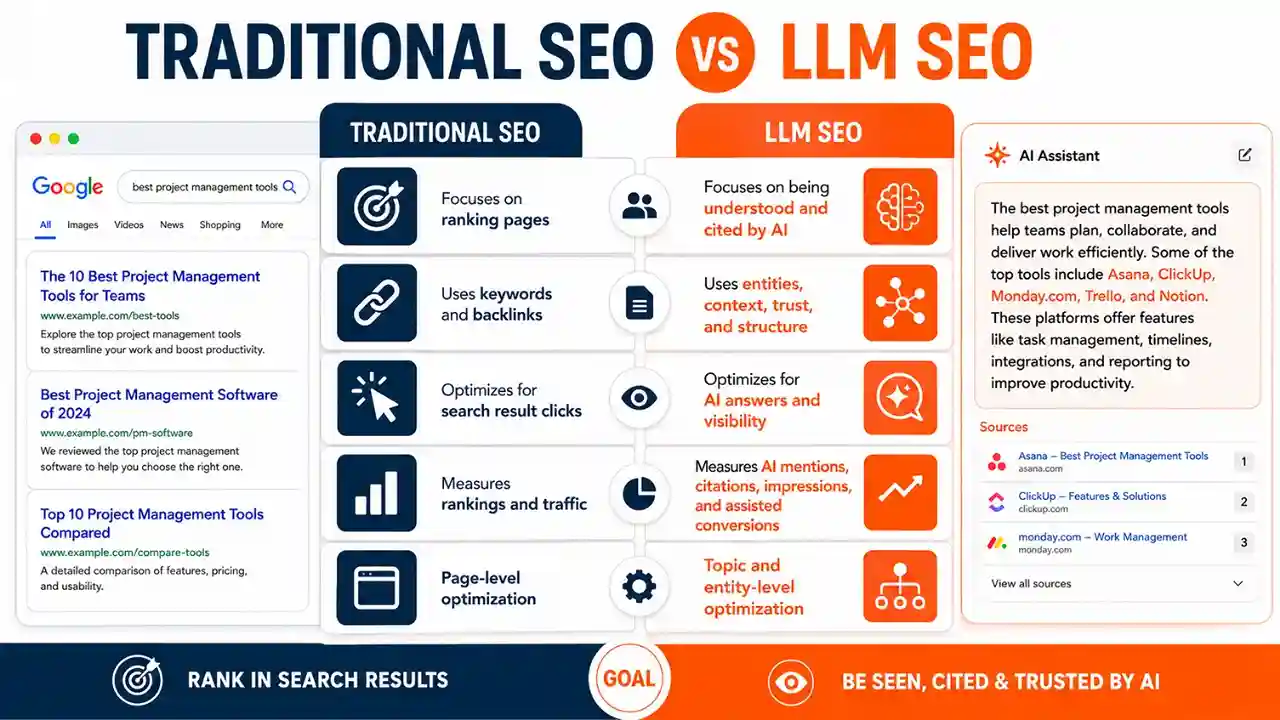
Google’s SEO starter guide emphasises how important traditional SEO features like keywords, crawlability, internal links, page speed, backlinks, and technical health still matter. However all of the above alone is not enough today for earning a decent amount of visibility.
AI search has fundamentally changed how information is selected and presented. Earlier, the searchers had the agency to choose what information they would look at. Now they do not. AI overviews pull information from multiple content to give you the most precise answer. You do not have to actually visit a page any more to have your curiosity quenched. You will also no longer be able to learn anything more than your question allows you to learn (terrible times)
Since content is actively being summarised, sometimes even transformed to fit the user’s question, it is no longer enough to rank on the first page of Google (a large part of the first page is after all already filled with AI. As writers we have to now write keeping in mind what could be the possible queries a user might have.
A well ranking page may not be understood by AI if it is poorly structured, lacks clear answers, has no author credibility, repeats generic content, or fails to show that they are backed by evidence. Similarly, content written only for keyword density may not perform well in LLM-driven experiences because AI systems need meaning and context.
Creating Content That AI Can Trust
It is very important to note that one of the primary intentions of AI search is to reduce uncertainty as much as possible, especially for topics that surround money, health, safety, legal decisions, or major purchases. Therefore trust is central to LLM SEO.
Google’s helpful content guidance reiterates that content should be created for people and not systems. This is because creating for systems is equivalent to creating in a highly formulaic way that can trick the system into believing that the content is helpful while it is actually not. Therefore originality, authority and trustworthiness is rewarded by most search engines. If it were not for these, we would be endlessly swimming in AI slop which I think we soon will, anyhow.
Here’s a few helpful tips that will make your content more helpful to users in general and for AI engines to cite:
- Be specific and avoid vague statements like poisonous snakes. Don’t write “SEO is very important.” Instead, explain what it means, how to do it and what are the advantages clearly, in a well-structured article.
- Show that you have expertise. Add author bios, credentials, first-hand experience, original examples, screenshots, case studies, or practical steps.
- cite reliable sources. Use official documentation, research papers, government sources, recognized industry bodies, and primary data whenever it is possible and relevant. Don’t go around namedropping however just to get the points. Try to make actual meaning like an actual human being.
- Keep your content duly updated. AI search systems prefer current information for fast-changing topics such as algorithms, laws, tools, pricing, and platform features.
- Never mass produce thin content just to show Google or other engines how consistent and fast you are, that is not the point. Note that Google’s guidance on AI-generated content says using AI is not inherently against its policies, but using automation to manipulate rankings violate spam policies.
Optimizing for AI Overviews and AI Search Engines
AI search engines and overviews reward content that directly answer user questions but that does not mean you should be writing short articles exclusively. In fact it is far better to write long and detailed content, this significantly increases your chance of being cited by AI for specific user queries. It will also help you perform well in long tailed keywords.
The following quick structural changes will get your content noticed:
- A direct answer near the top.
- Clear headings.
- Use descriptive H2s and H3s that match real user questions (like a pain point a confusing concept, a simple hack)
- Write short explanatory paragraphs because AI systems can more easily extract clean, self-contained answers.
- Add examples wherever realistically possible.
- Organised lists of pros and cons, step-by step guide, tabulated differences, all this work well with AI.
- A lot of information already resides on the internet, you have to make sure you bring your own signature insights into what has already been spoken about if you want to be visible.
- Never forget the technical parts like adding internal links, a meta description, a defining slug.
The Role of Structured Data and Entity-Based SEO
Structured data is code that enables search engines to comprehend a page. It can describe products, articles, organizations, FAQs, reviews, events, videos, recipes, and more. Google says structured data helps it understand page content and can make pages eligible for rich results when guidelines are followed.
For LLM SEO, structured data is useful because it reduces ambiguity. For example, if your page mentions “Apple,” structured data and context can help clarify whether you mean Apple the company, apple the fruit, or a different entity.
Entity-based SEO means optimizing around things, not just keywords. An entity can be a person, brand, product, place, organization, concept, or event. Search engines and AI systems try to understand relationships between entities.
For example, “LLM SEO” connects to entities such as large language models, Google AI Overviews, structured data, Search Console, content quality, semantic search, and digital marketing.
To improve entity clarity:
Use consistent names for your brand, products, services, and authors.
Create strong About, Contact, Author, Product, and Service pages.
Use Organization, Article, Product, LocalBusiness, FAQ, or other relevant schema where appropriate.
Link related pages together using descriptive anchor text.
Mention important related concepts fluently within the content.
Schema.org describes structured data vocabulary as a shared way to describe entities, relationships, and actions on the internet.
Building Topical Authority for LLM Visibility
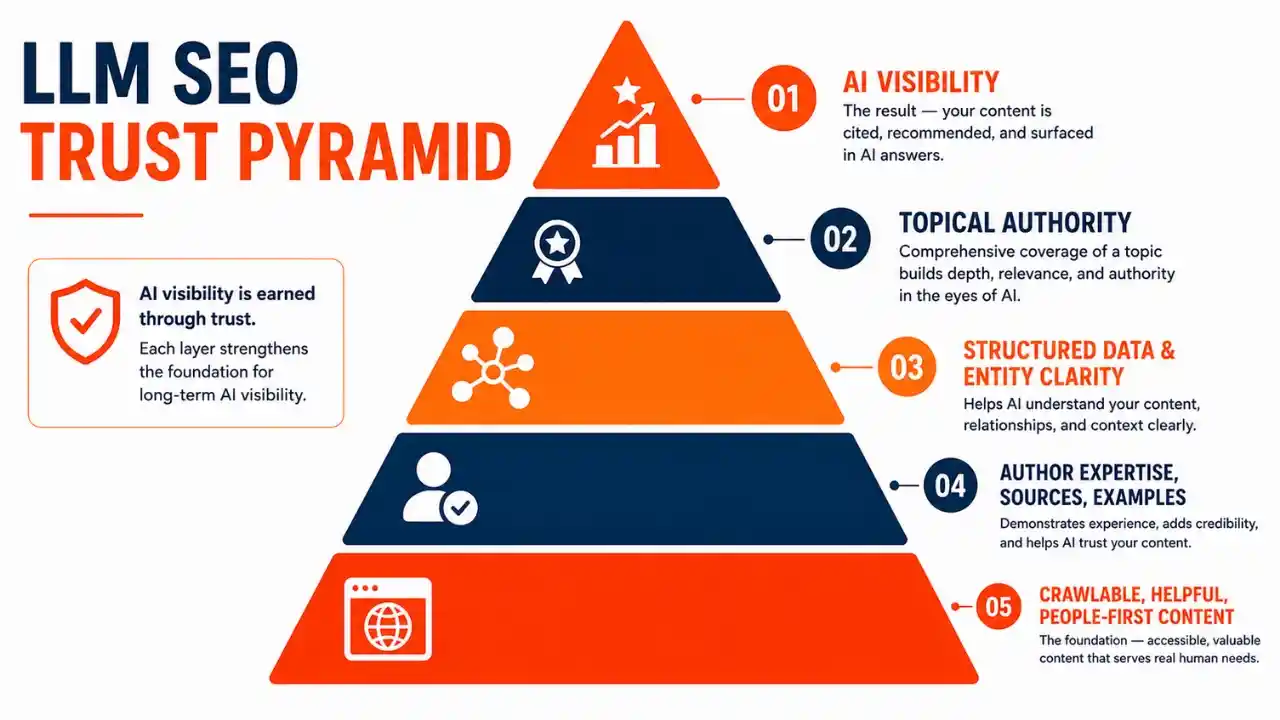
Topical authority means your website demonstrates deep, consistent knowledge about a subject. One article is rarely enough. AI systems and search engines need repeated evidence that your site covers a topic well.
For example, if your website wants visibility for “AI SEO,” you may need pages on AI Overviews, LLM SEO, structured data, entity SEO, content quality, Search Console reporting, AI content policy, and prompt-based search behavior.
A strong topical authority structure usually includes:
A pillar page that explains the broad topic.
Supporting articles that answer specific questions.
Internal links connecting related pages.
Original examples, templates, data, or research reports.
Regular updates when the topic changes.
This matters because AI systems commonly need context. A single page may answer one question, but a well-organized topic cluster helps prove that your site is a serious source in that area.
Students should think of topical authority like a subject portfolio. One good assignment helps. A complete portfolio proves expertise.
Measuring LLM SEO Performance and Success
Measuring LLM SEO is still developing, but it is becoming more practical. Google has introduced generative AI performance reporting in Search Console, giving site owners dedicated visibility into impressions from generative AI features such as AI Overviews and AI Mode.
Important metrics comprise:
Generative AI impressions in Search Console, where available.
Organic clicks and impressions from traditional search.
Pages receiving visibility in AI search experiences.
Brand mentions in AI-generated answers.
Referral traffic from AI search engines and assistants.
Conversions from organic and AI-assisted traffic.
Engagement quality, such as time on page, scroll depth, leads, sign-ups, or purchases.
You should not measure LLM SEO only by clicks. AI search may influence users before they visit your site. A user may first see your brand in an AI answer, then search your brand later, then convert. That means brand awareness, assisted conversions, and authority signals matter.
A good student-level reporting framework would include three layers: visibility, engagement, and business impact. Visibility tells you whether AI/search systems are finding you. Engagement tells you whether users value the page. Business impact tells you whether the content supports leads, sales, subscriptions, or trust.
Common LLM SEO Mistakes to Avoid
- ignoring traditional SEO. LLM SEO does not replace crawling, indexing, titles, internal links, mobile usability, and content quality. It depends on them.
- publishing generic AI-written content. If your article says the same thing as hundreds of other pages, there is little reason for AI systems to select it.
- hiding your expertise. If a page has no author, no sources, no examples, and no evidence, it becomes harder to trust.
The fourth mistake is keyword stuffing. Repeating “LLM SEO” many times does not prove relevance. Thorough explanations and related entities are more useful.
The fifth mistake is using fake or misleading structured data. Structured data has to match the visible content on the page and follow platform requirements.
The sixth mistake is chasing hacks. Some marketers treat AI SEO as a trick. In reality, the most durable approach is clear, accurate, crawlable, well-structured, people-first content.
The seventh mistake is not measuring changes. If you do not track Search Console data, AI visibility, brand searches, and conversions, you cannot learn what is working.
Final Thoughts
LLM SEOhas in no way replaced traditional SEO components. It is an augmentation of it. The nature of SEO has changed dynamically in the past few years and it is fated to change more. As a digital marketer you must be aware of all the incarnations of SEO and learn how to master them.
Gyaner academy is the academic wing of one of the most renowned digital marketing agencies of Hyderabad, Webmonx and we specialise in making the skill of digital marketing accessible to as many people as possible, be it people from the industry or freshers. Check out our AI integrated marketing courses, especially our SEO course to learn more about the syllabi and our vision.
