

Local SEO: A Complete Guide for Beginners in 2026
Local search connects customers that are ready to buy directly to a business. Local searches are perhaps one of the most popular searches of all time. Local SEO helps businesses more effectively communicate with people who are looking to buy. The guide we have created will help digital marketing students and owners of businesses understand the relevance of Local SEO in a more holistic manner. However, the key information contained here are the strategies that will help you ace this particular form of SEO in 2026.
What is Local SEO and Why It Matters
SEO refers to Search Engine Optimisation. To explain simply, if not a little essentially, SEO helps human beings create websites that satisfy certain search engine algorithms. The ultimate goal is always to reach the searcher, but since the medium is the search engine, we should also keep in mind what works with it and what against.
Local SEO is then the practice of optimising a business’s online presence in such a way that it pops up without a glitch when people search for nearby places in order to avail a service, buy a product or simply discover new things that are near them. Like “restaurants near me”, “free for all drag theatre near me” and so on.
It is the urgency behind the searches that makes Local SEO especially profitable. People who are looking for nearby places have mostly already decided that they are going to buy or pay a visit. Local SEO therefore needs to done keeping in mind that the rconsumers are already at the top of the funnel.
Three shifts are identifiable in the definition of Local SEO in 2026, let’s take a look:
- AI overviews and other artificial intelligence systems now summarize local options directly on top of the first results page and they draw mostly on trustworthy business profiles, reviews, and consistent data. (Here building your businesses’ authority becomes highly important)
- Users no longer search exclusively on Google search. They can be looking for places across surfaces like Google maps, Apple maps, and obviously AI assistants like ChatGPT, Gemini and so on. Therefore, strategies that are built exclusively around traditional ranking will no longer be the most effective. Creators need to learn about AI SEO, which involves Answer Engine Optimisation (AEO), Generative Engine Optimisation (GEO) as well as LLM SEO.
- Searchers no longer need to visit a page to know about a businesses contact information and hours, meaning the Google Business Profile has effectively become many businesses’ new homepage.
Google Business Profile Optimization
Google Business Profile was formerly known as Google My Business. It is a free listing that allows businesses to appear in Google Maps, Local Pack and Search. Here’s how Google guides business owners to represent their businesses on Google Business Profile (GBP)
- They should represent themselves exactly as they are recognised in the real world.
- They must keep the address/service area accurate
- They should choose the fewest categories needed to describe the core nature of their business.
- They should maintain only one profile per location (in case of chain of businesses spread out across multiple locations)
Google’s help documentation further notes the following:
- Complete and accurate information is more likely to show up for relevant searches.
- It explicitly states that there is no way to pay your way through better local ranking. The system runs on relevance, distance, and prominence.
Practical priorities for 2026
- Primary Category – The more specific and narrow a category you choose for your business, the more visibility it will garner. For, people tend to be more specific in their searches nowadays. For example, if you list your cafe not simply as a “cafe” but as say, “queer owned pet cafe”, it will do you wonders. Also, we desperately need queer-owned businesses to come forward in India.
- Photos and videos – Photos and videos help users imagine themselves inside your business space. These are direct trust and relevance signals too. If people know before-hand what backdrop their experience in your business place will have, that will be able to role-play better in their heads and we all know, role-playing brings us to a decision quickly. Also, Google’s own data has associated profiles with photos with meaningfully more requests for directions and website clicks than photo-less profiles.
- Posts drive engagement – If you regularly post Q&As and recent images and videos, your profile will look alive and not like a ghost town that was once busy and lively and now deserted. Let your future consumers know that you exist! Rankings may not be affected by regular posts, but conversions will happen.
- Verification and accuracy- If your profile is stuffed with keywords, if people find out that your business is not what it appears to be on the internet, your account may be suspended. If an information mismatch is detected between your business’ website and its profile, you may be looking at a suspension.
Local SEO Ranking Factors
Three foundational factors affect Google local rankings, knowing them will help you represent your business optimally:
- Relevance – Obviously, this refers to how well a business’ profile matches with the user’s search.
- Distance – This is the most defining factor, how far is the local business from the location of the searcher.
- Prominence – How trusted the business organisation is by people. This is usually reflected in reviews and stars.
This format has largely remained the same for a long time, what has changed however is how each factor gets measured.
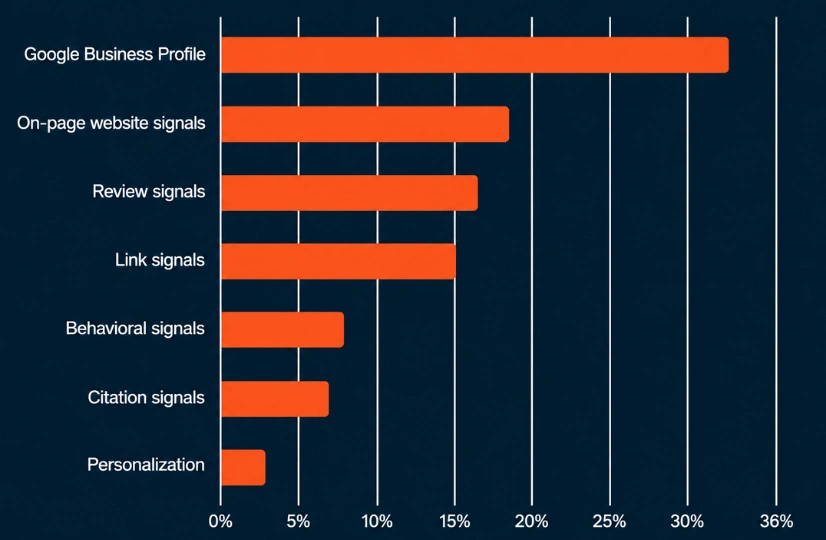
Whitespark’s annual Local Search Ranking Factors report attributes roughly a third of local pack ranking influence to Google Business Profile signals (categories, proximity, keyword use), a comparable share to on-page website signals like NAP consistency and local keyword usage, and smaller but meaningful shares to review signals, link signals, behavioral signals (clicks, calls, direction requests), and citation consistency
Local Keyword Research
Performing local keyword research is a clever way to match user intentions. If you are able to identify what phrases and keywords people use when they search for something nearby, you can incorporate them meaningfully in your content. It differs from general keyword research in one key way: intent is tied to both geography and urgency. Someone searching “emergency plumber near me” is ready to call; someone reading a blog about plumbing tips is still browsing.
There are three types of local keywords:
- Explicit Local Keywords – which names the location of the business explicitly. For Example, “Digital marketing institute in Ameerpet”.
- Implicit Local Keywords – It carries a local intent without mentioning the name of the place, example “emergency electrician” or “ order home-made meals”.
- Long-tail Local Keywords – These are highly specific, conversational keywords like “restaurant serving best shawarma in Old Hyderabad under Rs 200”
To craft efficient keywords include the following:
- Seed terms – service + location (shawarma, Old Hyderabad)
- Intent Modifiers – urgency words like “emergency”, cost apprehension words like “under Rs 200”, quality signals like “best”/ “top-rated”, convenience terms like “open now”
Note – Repeating “near me” over and over again will not make you relevant for local searches. It counts as spamming. Google is smart.
Local Citations and NAP Consistency
A citation refers to any online mention of a business’s Name, Address, and Phone number (NAP) on directories like Yelp, Bing Places, or the Better Business Bureau, in local news coverage, or on industry-specific sites.
NAP consistency means that information about the same place is identical on every platform it appears on. This is very important because search engines verify whether all information is valid and trustable across platforms. When the name, address, or phone number varies: “St.” versus “Street,” an old suite number, a disconnected phone line, Google has to work harder to confirm if the listing is legitimate. Ranking may take a dip if search engines have a hard time corroborating your information across channels. Some practitioners now refer to this as “NAPW” consistency, adding the website URL as a fourth element that also needs to match everywhere.
Here’s how to achieve optimal consistency:
- establish one canonical “master record” of the business’s name, address, phone number, and URL
- audit existing listings across major data aggregators and top directories to find mismatches
- correct them systematically, starting with the platforms that feed data to many smaller directories
Google Reviews and Reputation Management
Reviews are both ranking signals and conversion factors. People look into what other people are saying about a brand and their product/service before making a move. If your rating drops below 4.0 your conversion and ranking will take a dip. Google’s local ranking guidance ties prominence directly to review volume and rating quality.
A perfect score is not as important as consistency and authenticity. A steady flow of reviews makes more of an impact than a one time bulk of reviews followed by silence.
Google has also systematically tightened its review policies. It had come to their attention that people were coaching reviewers to mention specific staff names and drop particular keywords. Some people were also pressuring employees with review quotas. Google now treats these feedbacks as manipulated or coached reviews and discredits them.”Review gating,” where only satisfied customers are funneled toward a public review, is similarly discouraged, and sudden, unnatural spikes in review volume can trigger scrutiny.
The best way to build a reputation through reviews is to ask customers to leave an honest review and by responding to both positive and negative comments. Prompt responses directly signal trust.
Google Maps SEO: How to Rank in the Local Pack
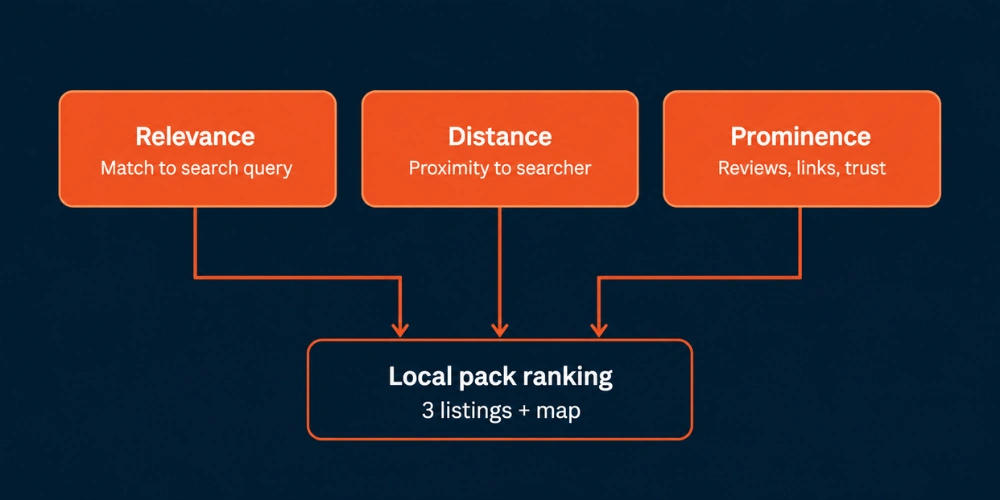
The Local Pack or Map Pack is the box of three business listings which are accompanied by a map which appears at the top of organic search results for location-based searches. Ranking here follows the same relevance, distance, prominence framework. There are a few map-specific factors that may aid your visibility:
- Accuracy of category – If your business is categorised under a broad category, it will not fetch nearly as much traffic as it will if it is specified exactly what the business does.
- Engagement signals like time spent on a listing, clicks, direction requests, phone calls indicate genuine customer interest Google’s local algorithm increasingly rewards profiles that show this kind of real-world activity.
- Working hours – Specifying exact times the business will remain open for each day of the week will help you see traffic because people often search for businesses that are “open now”.
- Schema Markup – Adding LocalBusiness structured data (following Google’s official developer documentation) to a website helps confirm the same details shown on the GBP listing, which is especially useful when a business’s website and profile might otherwise show slightly different information.
Local Link Building Strategies
Backlinks, that is, when other websites link to your business’s site, are still important for local rankings, but in 2026, it’s all about quality over quantity, primarily because it has become so easy to generate a huge amount of content with AI automation. One link from a trusted local newspaper, the chamber of commerce, or a well-known community group can do much more for your visibility than dozens of generic links from random websites.
If you’re just starting out, here are some practical and approachable ways to build local links:
- Get involved in your community: Sponsor local events, team up with nonprofits, or support schools and sports teams. These activities often lead to natural mentions and links from respected community websites.
- List your business in local directories and associations: Joining your chamber of commerce, getting listed with the Better Business Bureau, or finding industry-specific directories are all straightforward ways to earn valuable citations and links.
- Share your story with local media: If you have news to share—whether it’s a big milestone, a community project, or your expert opinion—reach out to local news outlets and community blogs. A thoughtful pitch can lead to lasting coverage and valuable links.
- Leverage your existing business relationships: Suppliers, contractors, and other local businesses you work with may have a “partners” or “resources” page. Asking for a mention there is an easy win that feels natural to everyone involved.
- Create content that’s truly useful for your local community: This could be original research, in-depth guides, or resources tailored to your area. When you solve real problems or answer common questions, people are much more likely to link to your content.
Common Local SEO Mistakes to Avoid
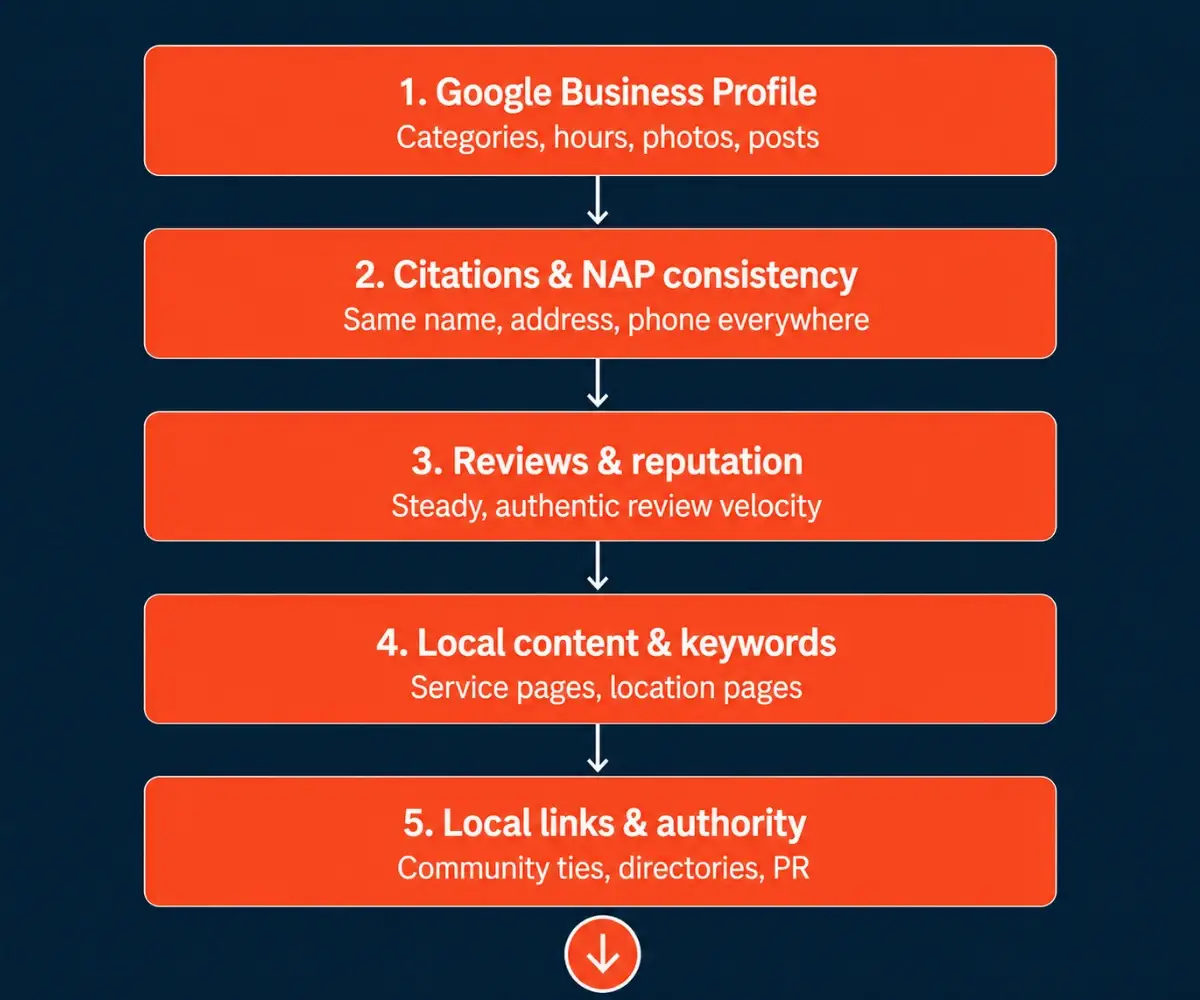
Even strong local businesses lose visibility to avoidable errors. The most frequent ones worth flagging for beginners:
- Treating Google Business Profile as a one-time setup. An abandoned profile with no new photos, no posts, and no review responses for weeks signals inactivity, and visibility tends to decay accordingly.
- Inconsistent NAP data across the web. Even small formatting differences (“Ste.” vs. “Suite”) can quietly undermine trust signals that took months to build.
- Ignoring reviews, whether that means failing to ask for them, failing to respond to them, or attempting to manipulate them through incentives or gated requests.
- Keyword-stuffing business names, page titles, or content with location terms instead of writing naturally for the people actually reading it — a practice Google’s spam systems are increasingly effective at detecting.
- Neglecting mobile experience. With the large majority of “near me” searches happening on mobile devices, a slow or hard-to-navigate site directly undermines conversions even when rankings hold up.
- Skipping local competitor research. Many businesses assume they know why they’re not ranking, when a look at who is actually winning the Local Pack often reveals the real gap.
- Creating near-identical “doorway” location pages for multi-location businesses, swapping only the city name. Search engines can detect this thin, duplicated content pattern, and it tends to suppress rather than help rankings.
Final Thoughts
Local SEO still rewards the same fundamentals, but because search happens across various platforms today, some of the ranking factors have changed A business’s Google Business Profile, website, citations, reviews, and links are no longer separate checkboxes; they function as one interconnected entity profile that Google (and increasingly, AI systems) cross-reference to decide who deserves to be recommended.
Despite being fragmented across platforms, one can predict what essentially signals trust to both people and search engines, the basics do not quite change, the terminology does. If you are a student who aspires to break into the field of digital marketing, or if you are an owner of a local business or a career switcher, you may feel overwhelmed by the sheer amount of information online about various forms of SEO. We at Gyaner offer digital marketing courses in Hyderabad that have a clean syllabus for each sector of marketing. Learning something systematically will go a long way in helping you build the perfect visibility strategy for your website.
