

Scroll-Stopping Advertisement with Google AI Max Campaigns : A Guide
Google Ads has changed a lot in recent years. People don’t just type short phrases like “buy shoes online” or “best digital marketing course” anymore. Instead, they ask questions in a more natural way, use AI features, search with pictures, and switch between different platforms before deciding what to do next.
To keep up with how people use search today, Google launched AI Max for Search campaigns. If you’re learning digital marketing, it’s helpful to understand AI Max because it is the path that lies ahead for paid search. In this context, the need to manage keywords by hand is no longer necessary. Focus needs to be more on using AI to match people’s intent,
What Are Google AI Max Campaigns?
It is important to note that AI Max is not a completely separate campaign type like Performance Max. More accurately, AI Max is a suite of AI-powered features that can be activated inside Search campaigns.
Google rolled out AI Max for Search campaigns in 2025. The main idea was to add smarter targeting and better ad creation to regular Search ads. In practice this is what it looks like:
- Instead of just matching the exact keywords you put in, AI Max uses, yes you guessed it, Google’s AI to look at your keywords, ads, landing pages, and even your whole website.
- This way, your ads can show up for more types of searches and the ad messages can be congruent with what people are really looking for.
Simply put, AI Max makes Search campaigns
- smarter.
- It expands reach,
- improves ad relevance,
- and automates matching ads to changing user intent.
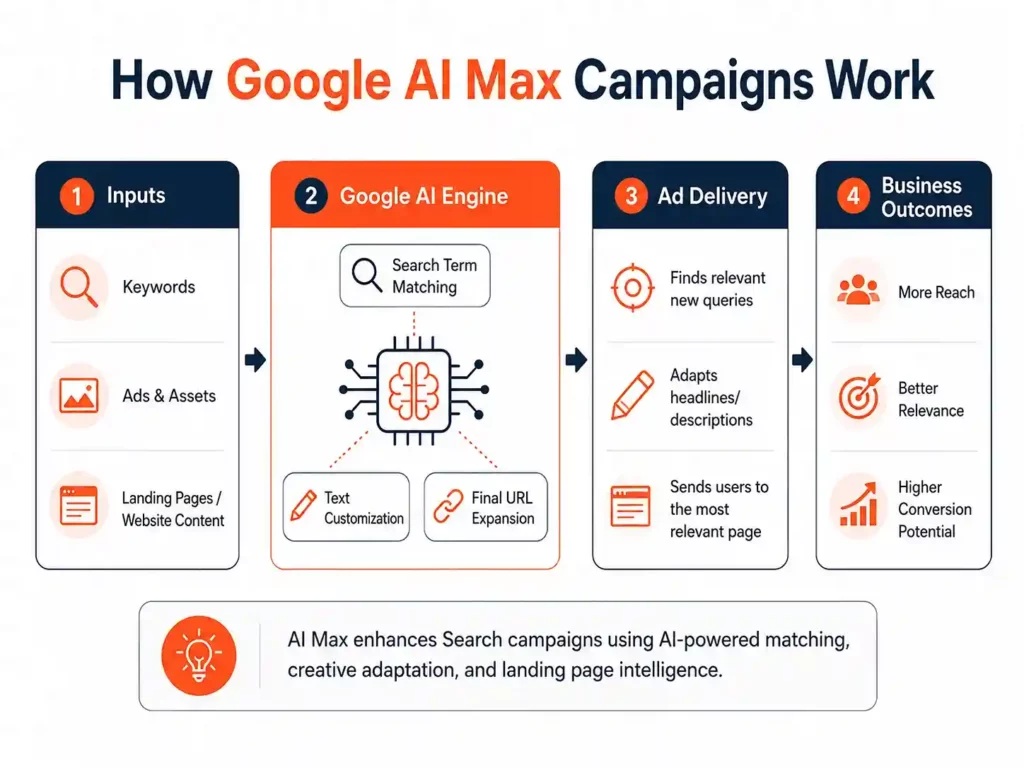
How Google AI Max Campaigns Work
Traditional Search campaigns depend heavily on keywords. An advertiser selects keywords, writes ads, chooses landing pages, and Google shows ads when searches match those keywords.
AI Max goes further. It studies three main signals:
- The keywords already present in the campaign
- The existing ads and creative assets
- The landing pages and website content
Using these signals, Google AI finds relevant search terms the advertiser may not have added manually. This is search term matching. It combines broad match and keywordless technology to find valuable queries that exact or phrase match campaigns might miss, creating a smoother link between inputs and outcomes.
AI Max also improves creative relevance through asset optimization. Google can generate or customize headlines and descriptions based on the searcher’s intent, landing page, and existing content. Building on that, Final URL expansion can send users to the most relevant page on the advertiser’s site instead of one fixed URL.
Key Features of AI Max Campaigns
- Search Term Matching – This helps campaigns discover new, relevant queries beyond manually entered keywords.
- Text Customization – This allows Google AI to generate or adapt ad text so that headlines and descriptions better match the searcher’s intent.
- Final URL expansion – This sends users to the most relevant page on the advertiser’s domain when Google predicts that a different page may perform better than the default landing page.
- Controls – Advertisers can use brand controls, location controls, URL exclusions, asset removals, and reporting insights. These matter because AI campaigns still need human strategy (look where we are at, we are debating whether AI needs us and not vice versa, you should stop reading and touch some grass immediately like right now). In other words, the advertiser guides the system and Google AI optimizes within that guidance.
Important Fact – In 2026, Google announced the expansion of AI Max into Shopping campaigns and travel-specific formats, indicating that AI Max is becoming part of a broader AI advertising direction.
AI Max Campaigns vs Performance Max vs Search Campaigns
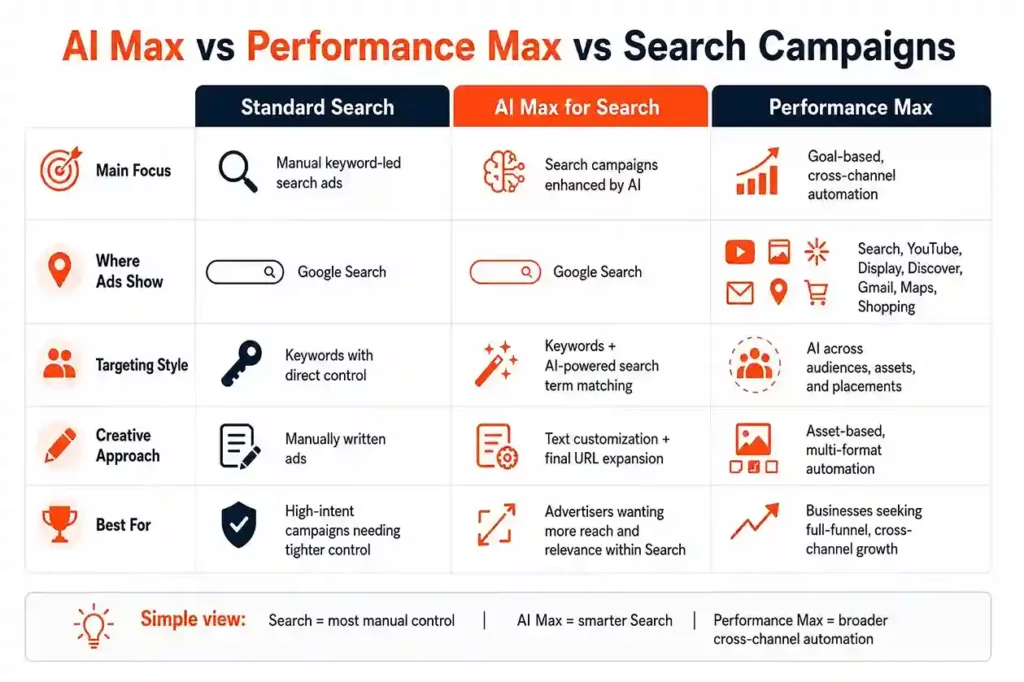
A standard Search campaign is keyword-led. Search campaigns are best understood as high-intent campaigns where users are actively searching for something.
AI Max for Search remains Search-based but adds AI-powered expansion and creative optimization. It keeps the Search campaign structure while making it smarter with keywordless matching (learn about how Google has come to understand that words have actual meanings that exist outside of the device), text customization, and landing page intelligence.
Performance Max is different. It is a goal-based campaign type that can run across Google’s full inventory, including Search, YouTube, Display, Discover, Gmail, Maps, and Shopping placements. By contrast, it uses Google AI across bidding, audiences, creatives, attribution, and placements.
Benefits of Google AI Max Campaigns
- Incremental reach – AI Max helps advertisers appear for relevant searches they might not have predicted when creating keyword lists. This means that the campaign can extend into more opportunities without changing its core Search structure.
- Ad relevance – Because AI Max can adapt ad text based on intent, users are more likely to see messaging that fits what they are searching for.
- Better landing page matching – Final URL expansion can redirect users to a more suitable page, potentially improving conversion rates.
- Time Efficiency – Marketers still need a strategy, but AI Max reduces the need to manually build every keyword variation and ad variation.
- Future Readiness – Search behavior is becoming more conversational and AI-driven. AI Max helps advertisers prepare for complex queries, AI Overviews, and new discovery-style search journeys.
Google says that advertisers have seen better results with AI Max, but it’s important to look at those numbers with a bit of skepticism. Whether you get good results depends on things like how well you track conversions, the quality of your website, how your campaigns are set up, your bidding choices, your budget, and what kind of business you’re running. AI Max can help, but it isn’t a magic solution. You will still need good marketing basics to see your pages succeed.
How to Set Up an AI Max Campaign
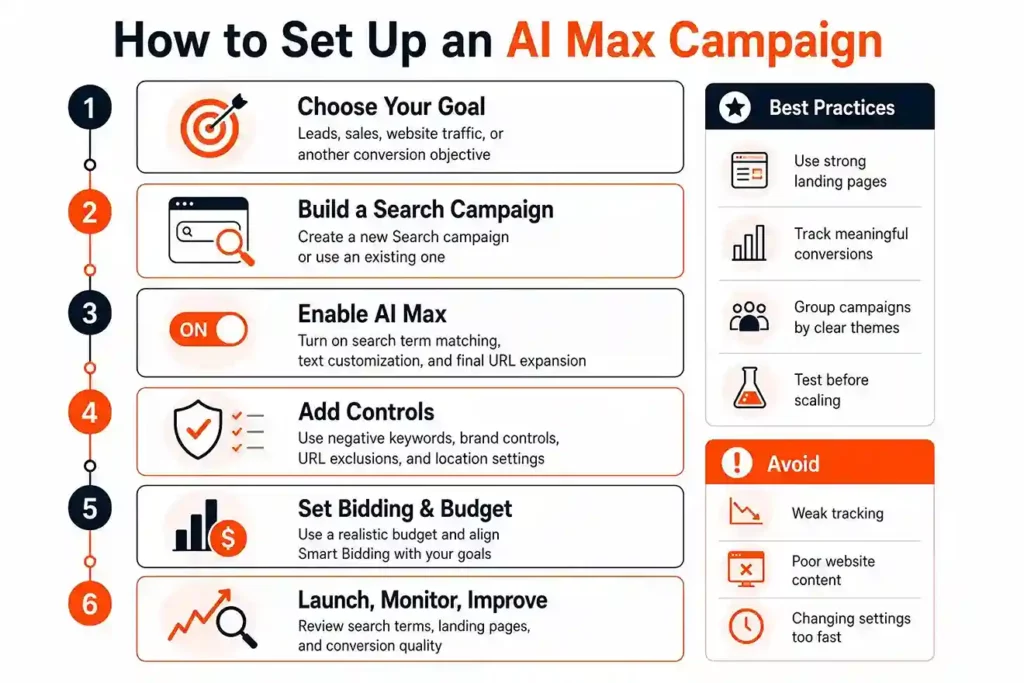
To set up AI Max, start with a Search campaign. You can create a new Search campaign or activate AI Max inside an existing Search campaign.
Step 1
Define the campaign goal. This may be leads, sales, website traffic, or another conversion objective. Strong conversion tracking is essential because AI systems need accurate data to optimize properly.
Step 2
Create your Search campaign in Google Ads. During setup, you will reach the AI Max section.
Step 3
Enable AI Max settings and select the features you want to use.
- Search term matching is usually the core feature. This allows Google AI to find new relevant queries.
- Text customization can help generate more relevant ad copy.
- Final URL expansion can help send users to better landing pages across your domain.
Step 4
Review controls. Add URL exclusions for pages that should not receive traffic, such as privacy policies, old offers, irrelevant blogs, or low-quality pages. Use brand controls when brand safety or competitor brand association is at stake. Check location settings carefully, especially for local businesses.
Step 5
Launch with a realistic budget and monitor performance. Beginners should ideally test AI Max through experiments or a controlled rollout rather than changing every campaign at once.
Best Practices for Better Results
- Start with a strong website – AI Max learns from landing pages and website content, so poor pages can lead to poor matching. Ensure product, service, pricing, and lead form pages are clear.
- Use accurate conversion tracking – Track meaningful actions such as purchases, qualified leads, calls, form submissions, or bookings. Avoid optimizing only for weak actions like page views.
- Group campaigns logically – AI Max performs better when the campaign theme is clear. A campaign for “law entrance coaching” should not be mixed with unrelated services like corporate training or school tutoring.
- Use Smart Bidding where required and appropriate – AI Max performs best when bidding and targeting align with business goals.
- Keep reviewing the search terms report – AI Max expands reach, but marketers must still check whether queries are relevant and add negative keywords when needed.
- Give the system enough time and data – Do not judge results after one or two days. AI-powered campaigns need learning time.
- Use experiments when possible – Testing helps compare AI Max performance against the existing setup more fairly.
Common Mistakes to Avoid
- Thinking that AI Max removes the need for strategy. It does not. Marketers still need to define goals, landing pages, budgets, exclusions, and messaging direction.
- Using weak landing pages – Since AI Max uses website content, unclear outdated pages can confuse the system.
- Poor conversion tracking – If Google Ads receives low-quality conversion signals, it may optimize toward the wrong users.
- Enabling every feature without reviewing controls. The Final URL expansion is useful, but URL exclusions remain important.
- Judging AI Max only by individual search terms. AI-powered matching can capture broader intent, evaluate overall conversion value, cost per acquisition, return on ad spend, and lead quality.
- Ignoring brand safety – Advertisers should use brand controls and negative keywords where needed.
The Future of AI-Powered Advertising
AI-powered advertising is moving toward intent-based marketing. Instead of simply matching keywords, ad platforms are trying to understand what users want, where they are in the buying journey, and which message will help them take action.
Google’s direction is clear. AI Max, Performance Max, AI Overviews ads, Shopping AI features, and conversational ad experiences all point to more automated, predictive advertising systems. Undoubtedly this has led to the breach of privacy, which unfortunately a lot of courts are more than willing to overlook. Honestly, I wish this article were about how to resist AI instead of how to lean into it. It is pretty horrifying to see AI persuading people to buy stuff that sponsors wars and genocides and completely messes up the environment. So, if you fail at doing this, you will actually win.
Look at this line that AI has generated for the blog “AI will handle more execution, but humans will still guide the strategy.” Did you count that this is the second time this is being declared in this article? Yes, we need to be very careful. You do not know who you are reading, am I AI or am I human or am I a cyborg?
Final Thoughts
Google AI Max campaigns combine the high intent of Search with the flexibility of AI-powered matching, creative customization, and landing page optimization.
If you’re just getting started with digital marketing, remember this: AI Max doesn’t replace the basics. You’ll get the best results if you set your goals clearly, have strong landing pages, track conversions carefully and consistently, and build your campaigns thought (ironical innit)
If you take the time to learn how AI Max works now, you’ll be ahead of the game. It’s about knowing how to point AI in the right direction (for more humane and less marketer purposes, I suggest you point AI in the completely wrong direction) with good information about your business and goals.
Take a look at Gyaner’s AI integrated Google ads and Meta ads course to not only gain a profitable exposure to the latest selling technologies but also to brush up on your basic skills, because the devil is always in the details.

