

Semantic SEO is the Only Way to Rank on Google: An Introduction (2026)
We had discussed in our previous blog on Post-AI Google updates about an update called Rankbrain. Which forever changed the nature of Google’s evaluation of a user’s search query. Google shifted from keyword matching, to meaning matching. Google was newly armed with technologies that allowed it to understand the meaning and the intentions behind the words that get typed in its search box. So today, if you search “twenty four hours libraries near me”, you do not simply get articles that have this exact same keyword. Instead Google analyses what it is you are looking for, and gives you results that are relevant to you and your location. This is Semantic SEO in action. The term “semantic” is a term used in linguistics and is used to refer to the meaningful content of language.
Table of Contents
ToggleWhat Is Semantic SEO?
The primary definition of semantic SEO can be obtained through its difference from traditional SEO. Traditional SEO focused on keywords, and treated these words simply as symbols, semantic SEO recognises the meaning of words and optimises search results in such a way that is cognisant of what the user means when she puts in a query. Instead of optimising around individual keywords, semantic SEO focuses on creating content around topics (therefore topic clustering has newly emerged as a key SEO tactic now).
To Summarise:
- Semantic SEO takes into account the intention behind a search, its meaningful content.
- Semantic SEO involves topic clustering instead of individual keyword optimisation.
A Brief History Behind this Shift
A series of landmark updates by Google enhanced its intelligence so as to shift from keyword matching to meaning recognition. Let us take a quick look at these updates
2012 – The Knowledge Graph
- A shift from matching strings of text to becoming cognisant of real-life entities like people, places, things and concepts and the relationships between them.
- Google could now understand that words pointed at real life things, that exist outside of texts. Language, to Google changed from being an end in itself to a referent, a symbol for real things.
2013 – Hummingbird
- One of Google’s biggest updates since 2001, Hummingbird enabled it to understand the intent and meaning of an entire query, not just individual words.
- For instance, a search like “best Bengali restaurant near me that’s open right now” could be understood holistically by Google, meaning it would look for results specific to your location and check their timings too.
2015 – RankBrain
- It is through RankBrain that Google introduced machine learning into its core algorithm.
- This enabled Google to associate words with broader topics and helped it handle new queries (more or less 15% of all search queries are completely new to Google) by matching them to similar, previously observed patterns.
2019 – BERT
- BERT helped Google understand contexts, especially the context of words in sentences.
- Previous systems that read a sentence word by word, BERT looks at all the words in a sentence together, what comes before a word and what comes after. You know that in almost all languages there exists words that are spelt the same but mean completely different things. For instance the term bank may refer to the bank of a river or the institution wherein money is dealt with. Google, with the help of BERT acquired the ability to understand the meaning of a word depending upon what words surround it.
Key Concepts in Semantic SEO
Search Intent
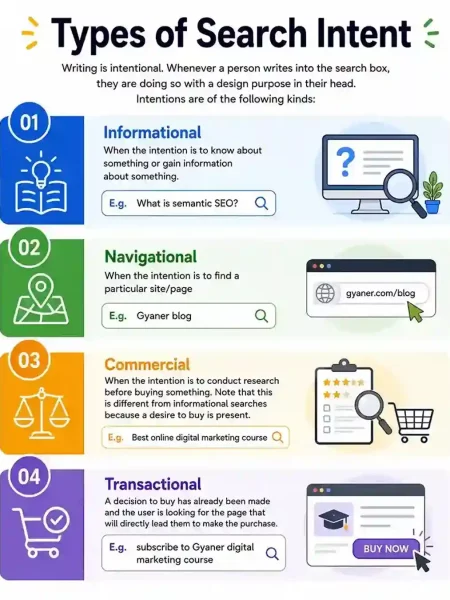
Writing is intentional. Whenever a person writes into the search box, they are doing so with a design purpose in their head. Intentions are of the following kinds:
- Informational – when the intention is to know about something or gain information about something. E.g. What is semantic SEO?
- Navigational – when the intention is to find a particular site/page Eg: Gyaner blog
- Commercial – when the intention is to conduct research before buying something. Note that this is different from informational searches because a desire to buy is present. E.g. Best online digital marketing course
- Transactional – a decision to buy has already been made and the user is looking for the page that will directly lead them to make the purchase E.g. subscribe to Gyaner digital marketing course.
To a content writer/creator semantic SEO involves aligning the content to better match the intentions of the user’s queries.
Entities, Not Just Keywords
Google’s knowledge graph allows it to understand that words refer to real entities. Therefore, when you are creating/writing, you have to ensure that Google knows that you are talking about a particular entity that exists not just in words but outside of the symbolic realm of language too.
Gyaner Institute for instance has a website. It has blog articles, service pages, contact information and addresses. All of which point to the fact that Gyaner exists as an institution outside of what has been written about it.
Topics Over Keywords
With Google’s capability of understanding intentions, it also realises that certain words often behave synonymously to one another. For instance if you search “best link building tips” you will be shown results that are differently worded like “link building best practices”, “link building strategies” and so on. Earlier content creators would focus on dedicating separate pages for each of these results, so as to maximise their reach. Now, having a single comprehensive article on link building will show up on results even when exact word matching has not happened.
The Topic Cluster Model: Semantic SEO in Practice
One of the most powerful implementations of semantic SEO is the Topic Cluster model. We have written a comprehensive blog explaining what clustering is. Here we shall give you a basic overview.
Pillar Page – This is a comprehensive post on a particular topic. Its scope is broad enough to introduce readers to all key elements of the topic and contains links to further detailed articles written on the sub-topics it introduces.
Cluster Pages – Supporting articles that dive deep into specific subtopics that the pillar introduces. Each cluster page necessarily links back to the pillar page.
Internal Linking – Cluster pages are linked to the pillar and the pillar contains link to the cluster pages. This bi-directional linking helps Google understand that the pages are semantically (meaningfully) connected
This structure of content creation and publication signals to Google the site’s topical authority. The more comprehensive, useful, well structured your articles the better you will rank.
E-E-A-T: The Final Boss of Quality Check
Google’s Search Quality Rater Guidelines introduce a framework called E-E-A-T: Experience, Expertise, Authoritativeness, and Trustworthiness. These are qualities that Google looks for to come to a decision about the quality of your site.
- Experience – Does the author have first-hand experience of the topic they are writing on?
- Expertise – Does the content demonstrate deep subject-matter knowledge?
- Authoritativeness – Is the author or site recognised as an authority in this field?
- Trustworthiness – Is the content accurate, honest, and transparent?
It is not enough for writers to simply make sense, they have to prove that what they are writing about is accurate and authoritative. In order to prove your experience, add an author’s bio, get backlinks from trusted sources and have your article verified by industry experts.
Getting Started on Semantic SEO
Here is how you can begin:
- Identify a core topic your audience cares about that you can claim expertise on.
- Research search intent – look at what actually ranks for your target queries and understand what format and depth those pages take.
- Build a pillar page that covers the broad topic comprehensively, targeting the main keyword and related variations.
- Create 5-7 cluster articles that each answer a specific question or explore a specific sub-topic within a broader topic.
- Interlink everything – pillar links to clusters, clusters link back to pillar.
- Add structured data to your pages using Schema.org vocabulary (start with Article, Organisation, or FAQPage types).
- Focus on quality – write for humans, focus on being as comprehensive and easy to understand as possible. Only rely on valuable sources and do not take shortcuts like engaging in black-hat SEO practices.
Conclusion
Semantic SEO is good news for creative and innovative people who add to existing knowledge and unearth newer ways of thinking. Google’s shift from keyword matching to meaning matching, has correctly penalised creators who used to undertake black-hat practices, only to rank higher. In order to succeed as a website what you primarily need is radical originality and authenticity. Of course there are aspects of technical SEO like schema markup and keyword research, not to worry, these skills can be learnt very easily. Consider joining Gyaner’s digital marketing course in Hyderabad if you wish to brush up your basics on SEO, advertisement campaign creation, link building and performance analysis and AI. Build your instincts and technical skills with us, the rest, your creativity will handle.
FAQs
Semantic SEO is the practice of optimising content around the meaning and intent behind search queries, rather than just matching individual keywords. It focuses on topics, context, and user intent instead of exact-match keyword repetition.
Traditional SEO treated keywords as symbols to match, while Semantic SEO recognises the meaning and intention behind those words. This means optimising for topics and user intent rather than stuffing pages with specific keyword phrases.
A topic cluster is a content structure where a broad pillar page links to several in-depth cluster articles on related subtopics, all interlinked. This signals topical authority to Google and improves rankings across related search queries.
The four types are informational (learning something), navigational (finding a specific site), commercial (researching before buying), and transactional (ready to make a purchase). Matching your content to the right intent is central to Semantic SEO.
E-E-A-T stands for Experience, Expertise, Authoritativeness, and Trustworthiness — Google's framework for evaluating content quality. Demonstrating these qualities through author bios, credible backlinks, and accurate information helps improve your site's ranking potential.
The key updates were the Knowledge Graph (2012), Hummingbird (2013), RankBrain (2015), and BERT (2019). Each progressively shifted Google from simple keyword matching to genuinely understanding the meaning, context, and intent behind search queries.

