

Google Ads vs Meta Ads: Which is the Right Fit for Your Brand in 2026?
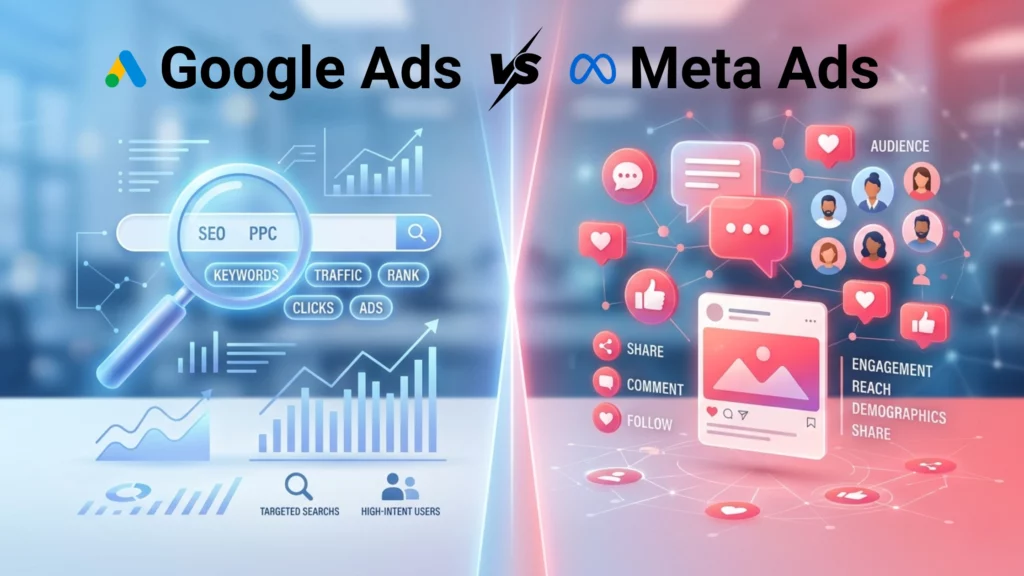
The primary and by far the most crucial difference between Google Ads and Meta ads is that, Meta Ads is responsible for creating demand while Google Ads captures existing demand.
Google ads
- Shows up mostly when people are actively searching for products and services
Note: Google offers a broader inventory through formats like Performance Max, Display, YouTube, Shopping, and Demand Gen where you can run campaigns on various platforms and not just on search results.
Meta Ads
- Running Meta Ads means running your ads on the following platforms: Facebook, Instagram, Messenger, Audience Network (beyond Meta platforms to high-quality third-party websites and mobile apps)
- These are ads shown according to audience signals, consumer behavior, and machine-learning-driven delivery
Table of Contents
ToggleKey Things to Keep in Mind about Google Ads and Meta Ads
Both Google and Meta Ads should be created in such a way so as to appeal to the user’s mindset when they come across such ads. A person comes across Google Ads when they are looking for a solution to an identified problem, on the other hand they come across Meta Ads without searching for them, it is shown to them based on their previous behaviour.
The following comparison chart will help you identify what kind of content works on each platform and help you get an idea of which platform you should invest in more, depending upon the nature of your business.
Factor | Google Ads | Meta Ads |
Targeting | Keywords, solutions | Interests, behaviour |
Creative Requirement | High authority, well researched | Images, videos, hooks, short form content |
Brand Building Fit | Strong through YouTube, Display, and Demand Gen, but not as socially immersive | Very strong for storytelling, lifestyle positioning, and repeat exposure |
New Brand/Established Brand | Better for more or less established brands, where search intent already exists | Better for introducing new brands/products/services to create curiosity and demand |
If effective for local businesses | Excellent for “near me”, urgent and service searches | Useful for creating local awareness, new attractive offers and retargeting |
Budget Efficiency Pattern | More efficient towards the bottom of funnel (when customer has almost made up their mind about buying) | More efficient at the top of funnel (when customer is learning about a new brand/product/service) |
Which Brands Should Invest More in Google Ads?
- When people know what they want to solve and are researching before buying (Dentist, Home services, repair, FMCG and so on)
- Google Search is specifically built to show ads to people actively searching for products and services, and Smart Bidding uses auction-time signals such as device, location, language, time of day, and more to optimize for conversion likelihood
- Google ads are beneficial for brands with a strong product feed, and a catalog people directly search for.
Performance Max, what is it?
When you want to run ads across multiple Google surfaces, like on other websites on google, youtube etc, you should use Performance Max. It is a goal-based campaign type.
The following types of brands should ideally invest more in Google Ads:
- Local services with urgent intent
- B2B brands with high-value, problem-aware buyers
- E-commerce brands in search-heavy categories
- Travel and hospitality with clear booking intent
- Healthcare and professional services
- SaaS products with known category terms
Which brands should invest more in Meta Ads?
- When a product is identity driven and visual (products that can essentially generate curiosity through visual cues)
- Brands that have a steady creative pipeline.
- Brands that sell innovative yet practical products, things that can ease simple chores, or make them more enjoyable.
The following types of brands should ideally invest more in Meta Ads:
- Fashion, beauty, and lifestyle DTC brands
- Visually demonstrable products
- New brands that need awareness before demand exists
- Coaching, courses, creators, and info products
- Impulse-buy or giftable product categories
- Brands with strong UGC, video, and storytelling assets
What if it Ain’t a Question of Either/Or?
Businesses should ideally not restrict themselves to one of the two platforms. If the budget is tight, the funds should be allocated to the platforms based on what the product is and where the target consumers are most likely to discover it. Here is a practical starting point:
- Intent-heavy businesses: 60–80% Google, 20–40% Meta
- Discovery-heavy brands: 60–80% Meta, 20–40% Google
- Balanced e-commerce brands: 40–60% Google, 40–60% Meta
Conclusion
In simple words, Meta Ads create demand while Google captures it. However consumer behaviour is often erratic, who know how one stumbles upon a product today. Wherever we look there is a product being sold, and a digital marketer’s dream is to have their product displayed everywhere.
This dream is not of course entirely achievable but we can help you take the right steps. Knowing the strategies of Google and Meta Ads right from the beginning, can help you save on a lot of money and time and fetch you results. Join Gyaner’s Google Ads and Meta Ads Course today and become a certified digital marketer. You require no previous expertise to learn with Gyaner, our goal is to make digital marketing an accessible skill.
FAQs
Google Ads captures existing demand from users actively searching, while Meta Ads creates demand by showing ads based on user behavior and interests.
Meta Ads is better for new businesses because it helps build awareness and generate demand through engaging visuals and storytelling.
Use Google Ads when customers are actively searching for solutions, such as local services, healthcare, or high-intent purchases.
Meta Ads performs best with short videos, images, and engaging creatives that grab attention and drive curiosity.
Yes, combining Google Ads and Meta Ads helps cover both demand capture and demand creation for better overall results.

