

A Paragraph Can Make or Break Your SEO: An Introduction to Google’s Passage Indexing

Table of Contents
ToggleWhat Is Passage Indexing?
Passage Indexing is a 2020 Google update that enables the search engine to understand and rank particular paragraphs within a longer article rather than evaluating and ranking the whole page. In other words, a single paragraph now has the ability to boost your ranking, provided it answers a frequently asked question effectively.
This development aligns with Google’s commitment to prioritize meaning over form and other technicalities. As a result, passage indexing represents Google’s continued move towards semantic SEO.
What Has Changed?
Previously, Google decided whether your page deserved to rank for a particular search query by assessing the relevance of the entire content. Now, with passage indexing, it can rank your content higher if a particular paragraph or section more accurately answers the user’s query than competing pages. Therefore, even if your brand image or the head title does not convey an answer to a specific query, your page can still achieve higher rankings based on the relevance of its passages.
Note: Martin Splitt from Google’s Developer Relations has confirmed that despite the name, Passage Indexing is about “ranking” and not about “indexing”. Google still indexes entire pages as it customarily does.
How Passage Indexing Works
The system relies on two things primarily:
- Natural Language Processing (NLP)
Google’s NLP algorithm allows the search engine to understand the context of a write-up, the intentions of both the writer and the user who queries, and the relationships between words within a given sentence or passage.
- Machine Learning (ML)
This helps the search engine categorize and prioritize this information to match it with user queries.
Here are the steps this process follows:
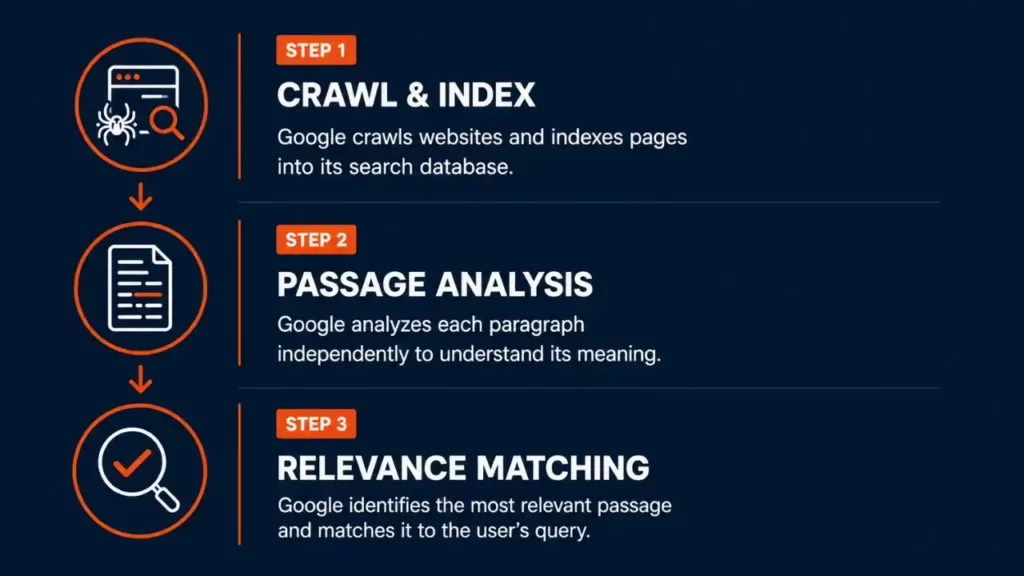
Step 1
Crawl & Index: Google crawls and indexes entire pages. Nothing has changed here.
Step 2
Passage Analysis: The new Google algorithm breaks down the content into its smaller constituent parts like paragraphs, sub-sections, and so on. It understands each paragraph independently.
A Tip to Writers: Make sure to design each paragraph in such a way that it makes sense entirely on its own. A user should be able to fully comprehend it, even if they have not read what has come before it.
Step 3
Relevance Matching: Google’s system evaluates not just which pages are most relevant, but which passages within those pages provide the most precise answer to a particular user query. Often, the most relevant section is shown as a featured snippet or appears highlighted.
Why Passage Indexing Matters for SEO
For digital marketers, this shift brought by passage indexing introduces both new opportunities and new responsibilities.
- One significant change is that long-form content now gains importance in SEO strategies. The more detailed your content, the higher the likelihood it contains the information users may seek.
- Because each passage is independently assessed, underdeveloped paragraphs can negatively affect performance. While this system rewards information-rich writing, it may deprioritize content focused on creativity or nuance outside Google’s assessment capabilities, driving greater uniformity in digital content.
- At the same time, users are increasingly asking Google more complex and highly specific questions. Long tail keywords hold greater priority today, so you should focus on writing naturally, rather than keyword stuffing for reach. Write as humans are meant to write, not simply to rank with a search engine.
Difference Between Traditional Indexing & Passage Indexing
To better understand the impact of this change, it helps to compare the old and new approaches side by side.
Traditional Indexing
- Evaluates the entire page as a single document.
- Its overall relevance, including title, meta description, banklinks, topical focus, and keyword accuracy, is rewarded.
- The page will rank only if its primary topic matches a user’s query.
- Even if a particular part of the document produces an exact answer to a query, it won’t rank high because of it.
- Users have to sift through large documents to find exact answers.
Passage Indexing
- Particular paragraphs can boost the rank of a page if they match the user’s query.
- Even if the entire document does not look like it might answer a question on a particular topic, if it does so, it will be rewarded with a higher ranking.
- Passages are independently evaluated and processed.
- Primary focus is on intent matching rather than keyword matching.
- The document’s status from backlinks and topical authority remains important, but now individual passages can significantly influence ranking.
How Google Identifies Relevant Passages
Google analyzes language computationally, identifying semantic patterns to evaluate relevance. Its models identify content value mathematically, not intuitively. Factors influencing recognition of relevance include:
- NLP models assess the meaning behind words by seeing if those words are contextually relevant, naturally occurring, and related to the topic organically. Google’s post-AI Google updates, RankBrain and Bert, allow it to understand the meaning behind words and the meaning of words in a sentence.
- Google’s algorithm relies on HTML structures, headings, and sub-headings (H2,H3), paragraph breaks to understand where one meaningful content ends and another begins. Proper structuring and chunking of content allows Google to better evaluate standalone sections.
- Passages that are written as direct answers to what or how questions have a better chance of being ranked.
- Although passages are independently ranked, site authority, domain strength, backlinks, and depth remain vital. Your established reputation will keep your content competitive as others adopt answer-oriented strategies.
Common Passage Indexing Mistakes
- Exclusively producing short-form content limits your ability to leverage passage ranking benefits.
- Writing paragraphs that cannot stand on their own and depend heavily on context to be understood.
- Keyword Stuffing – NLP helps search engines understand the meaning behind texts. If you try to write passages around keyword density, your authority is going to suffer.
- Do not assume passage indexing supersedes comprehensive SEO. Fundamental elements—authority, technical health, backlinks, and E-E-A-T—remain critical. Passage Indexing is incremental, not a replacement for core SEO strategies.
- If you rely on over-optimizing, that is, writing unconnected passages to trick the algorithm, your content will not remain user-first and cost you reach and authority.
Best Practices to Rank with Passage Indexing
- Structure your long-form content using proper headings and subheadings.
- Make sure your headings and subheadings aspire to address pain points and gaps in knowledge.
- Use Google Search Console to find out what kind of queries are driving clicks and impressions to your pages and plan your content surrounding these queries.
- Google is slowly but surely phasing out featured snippets in favor of AI overview, bullet points, steps, and “how to” and “what is” based answers are favored.
- Write high-quality and elaborate content that truly makes sense to users and maintain your on-page SEO, because your passages will get more attention if your page fulfills E-E-A-T criteria.
Conclusion / Final Thoughts
Lyotard in his 1979 book “The Postmodern Condition” had made a prophetic observation that with the advent of computers and its ways of storing, knowledge is going to be turned into information. What is the difference between knowledge and information? I shall tell you what it is. Today, if you have a complex question and you put it to Google or even any AI chat, no matter whether or not this particular question has been properly answered by someone or not, it will generate an answer. No matter what you will get an answer. You do not have to find out on your own, you do not have to read a substantial amount to form an opinion. You will be given a manufactured answer. That prioritises algorithms and recurrent search behaviours. This is information. Knowledge involves critical thinking, personal reflection but information is simply a commodity.
I shall conclude with a note of hopelessness rather than further advise on how you can optimise your content. Google keeps saying that you should write for humans, but it privileges standalone paragraphs that can work independent. This is a paradox humans do not write like that. They introduce a topic, contextualise it and then present it. There can exist no one line answers for every query. This human, that we are supposed to write for, is also manufactured by algorithms. They want information and not knowledge because knowledge takes time and nobody has the time anymore.
FAQs
No. Traditional indexing ranks the whole page. Passage Indexing can rank a single paragraph within it.
No. Just structure your content with clear headings and self-contained paragraphs.
No. Strong SEO fundamentals still matter. Passage Indexing builds on top of them, not around them.
Long-form, in-depth content. The more sub-topics your page covers, the more passage-level opportunities you create.
Passage Indexing finds the most relevant section on your page. Featured snippets are how Google displays it.
Rarely. Passage Indexing needs multiple distinct sections to work. Short pages don't give Google much to pick from.

