

Make your Website Visitors Stay Longer: An Introduction to Content Chunking

Table of Contents
ToggleWhat is Chunking?
Think about how often you have left a page just because the information available on it looked tedious to read or remember. Several content writers, till date, write paragraphs upon paragraphs explaining a concept. That does not work, content needs to be delivered to readers in:
- Smaller
- Coherent and
- Self contained units.
This form of breaking down and presentation of information helps the human brain to better understand and remember the contents. This process is called chunking. It is called so obviously because it refers to the practice of long texts into smaller chunks of texts. Chunking is therefore an editorial technique that helps both humans and AI now, read/parse your written content better.
Chunking Techniques in Writing
Chunking involves, structuring your articles, landing pages and campaigns using:
- Clear H1, H2, H3 headings i.e. clear headings and subheadings.
- Short and crisp paragraphs
- Bullet points
- Numbered steps
- Visual separators, clearly demarcating one section from another.
The Psychology Behind Chunking
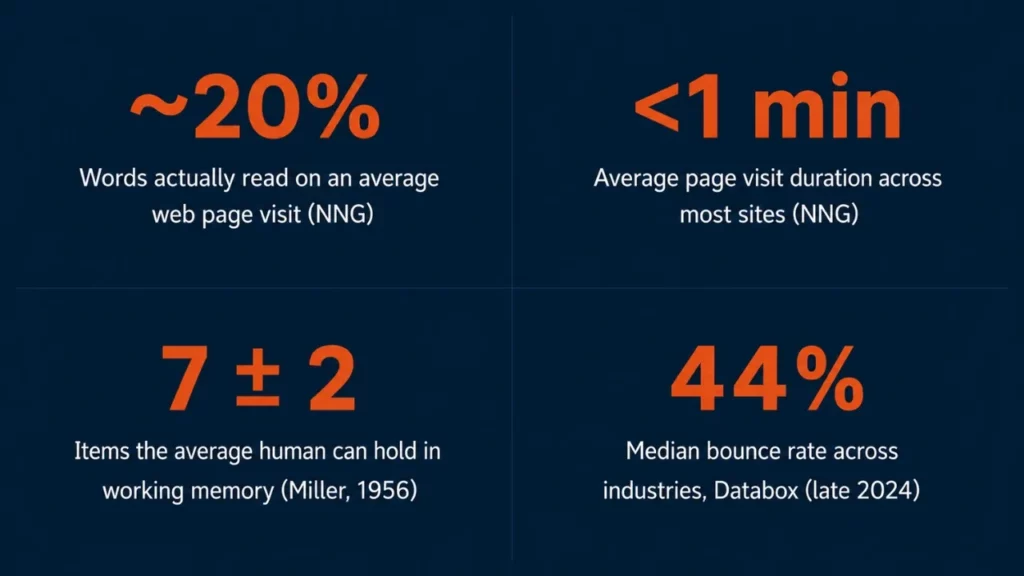
George A Miller, a cognitive psychologist at Harvard University, published a paper in 1956 titled “The Magical Number Seven, Plus or Minus Two: Some Limits on Our Capacity for Processing Information.”
- Wherein he propounded that the average human brain can hold approximately 7 (plus or minus 2) items at any given time.
- When the threshold is crossed, learning stops.
- He also said, when the information is presented in chunks, it becomes easier to remember.
Think of a mobile number, if it is presented as such: 98XXXXXX03 it is difficult to remember, but the moment we break it 98XXX XXX03, it becomes easier to commit to memory.
The Importance of Chunking
The Nielsen Norman Group, considered to be the world’s leading UX research firm made the following discoveries after conducting a research on how people read online content, through eye-tracking:
- People do not read online content, they scan it.
- The average page visit lasts less than a minute, during which they can read only a quarter of the words on the page.
- Scanning behaviour follows an F-shaped pattern i.e. users read horizontally across the top, a shorter horizontal sweep further down, then a vertical scan along the left side.
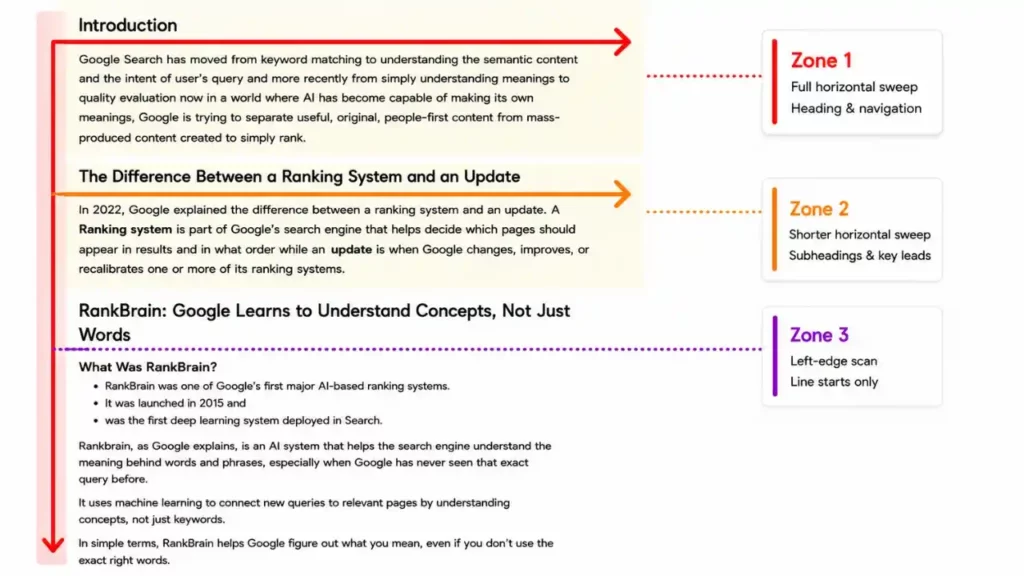
As a content creator, you must therefore always place your most important information within the F zone so as to draw maximum attention to it.
Importance of Chunking in Increasing Accessibility
Chunking makes content accessible to:
- persons with cognitive differences
- Non-native speakers
- persons using smaller screens to access the content (increases mobile-friendliness)
Importance of Chunking in SEO
- Google’s Passage Ranking AI, which was launched in February 2021 helps the search engine evaluate individual sections of a page instead of the whole.
- This helps Google identify which passage best answers a particular user query. (refer to our blog on Answer Engine Optimisation to know how you can write to answer specific questions instead of simply explaining concepts)
- Chunking effectively will help specific sections of your content to rank for specific queries.
Importance of Chunking in Creating AI Visibility
- AI powered answer engines and tools use something called “Retrieval-Augmented Generation” (RAG) to retrieve smaller clumps of text from a large body of text to answer specific queries accurately.
- Clearly defined chunks of text makes it easier for this system to retrieve information from your content.
Importance of Chunking in Enhancing User Experience
- Easily navigable pages retain users longer
- Poor formatting and UX increases bounce rates
Types of Chunking
Chunking, as we have already discussed, helps both humans and AI systems to better understand your content. Though you must always write keeping in mind that your readers are humans, technical chunking does help RAG systems to better retrieve info from your content and make them visible in AI chats and overviews.
Editorial or Human-first Content Chunking
Editorial or Human first content chunking refers to the structuring and presentation of content that helps human readers. There are three scales at which editorial chunking operates:
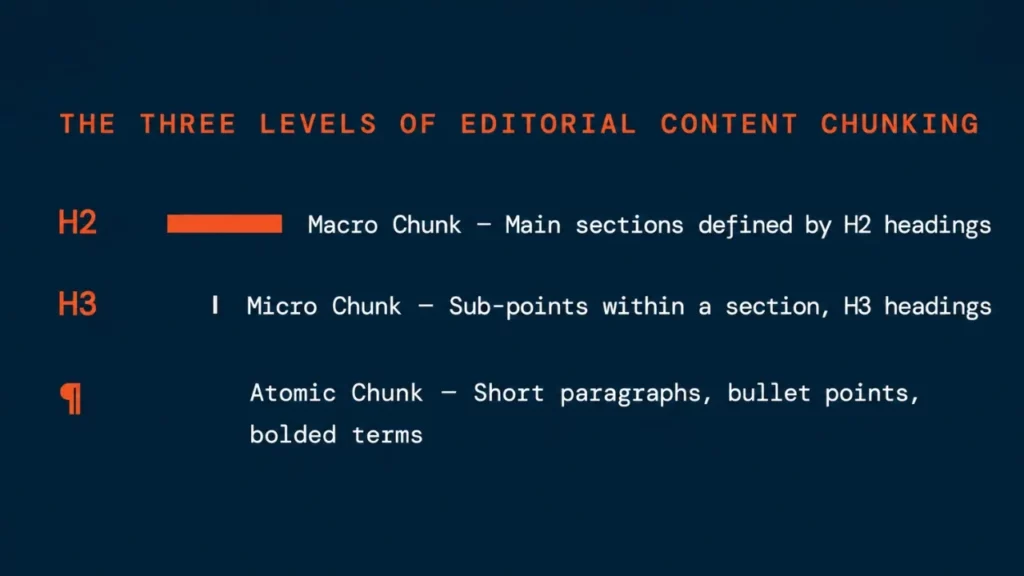
- Macro chunks give readers a bird’s eye view of the content
- Micro chunks allow them to know specific subtopics.
- Atomic chunks make individual ideas digestible.
Types of Technical Chunking to Help AI Systems
Fixed Size Chunking
- Wherein text is divided into segments of a set number of tokens or characters regardless of whether meaning is complete.
- It is simple and fast, but can split ideas mid-sentence.
Sentence Based Chunking
- Text is split at sentence boundaries.
- Grammatical completeness is preserved (unlike fixed size chunking)
- Works well for FAQ-style or short-answer content retrieval.
Paragraph Based Chunking
- Chunks align with paragraph breaks,
- Respects the author’s intended structure.
- Effective for well-organised editorial content like news articles and blog posts.
Semantic Chunking
- Chunks are formed by grouping sentences with similar meaning,
- Embedding similarity is used to detect topic shifts.
- Preserves conceptual coherence
Hierarchical Chunking
- Documents are split at multiple levels: chapter → section → paragraph
Google’s Opinion on Chunking for AI SEO
Google’s AI Optimisation Guide says the following important things:
- “ There’s no requirement to break your content into tiny pieces for AI to better understand it.”
- “Google systems are able to understand the nuance of multiple topics on a page and show the relevant piece to users.”
- “However, sometimes shorter (or longer) pages can work well depending on your audience and subject matter.”
The Takeaway
- Create human first content
- Use chunking only to better structure your content and make it memorable
- Do not unnecessarily break your content down into micro pieces. Meaning making is the most important. (read our article on semantic SEO to understand how Google rewards coherent and meaningful content)
Chunking Mistakes to Avoid
Over Chunking
If you break down your article too much, that will make the user’s reading experience fragmented. Remember that chunking is supposed to make your article flow better. Always keep asking yourself, how to best present my text in a way that can be more easily remembered.
Under Chunking
Under chunking is perhaps even more harmful than over chunking. If you keep writing blocks upon blocks of unstructured text, people will simply not read. The kind of literature that digital marketers produce are not the kind of literature that people read to entertain themselves. Content writing for DM is highly utilitarian. The more digestible and informative your content, the more it shall be appreciated.
The Folly of Vague and Generic Headings
Marketing is all about making everything sound desirable. Make your readers want to read what you write by using headings and sub-headings that draw attention. Identify pain points and gaps in knowledge to write attractive captions. Avoid using generic titles such as “introduction”, “overview”, “details”, “miscellaneous” that offer readers no direction.
Creating Chunks That Cannot Stand Alone
Each chunk should be able to stand independently on its own. If someone directly jumps to a specific section from the table of content, they should be able to understand it without having to go through everything that came before it. If this does not happen the chunk has failed its UX function.
Unconnected Chunks
Every chunk should connect naturally with what comes before it and give way to what will come before it. The entire article should read like a united piece of writing. Always write logically and sequentially.
Conclusion
Chunking is all about making complex information accessible. The better your content is structured the longer you will be able to hold your reader’s attention. Not to mention it is also helpful for the writers, because it helps them keep track of what key points they have covered and what else is there to be added. Chunked content can also be easily updated. Say, Google publishes new documentation on chunking. I will be able to go to the section dedicated to Google’s opinion on chunking and update it. Chunking is not a skill that requires a lot of time and effort to master, all you need to do is pay attention to what kind of informational written content holds your attention more and apply the same tactics to your own pages.
FAQs
Content chunking is the practice of breaking long text into smaller, self-contained units using headings, short paragraphs, and bullet points to aid readability and recall.
Chunked content keeps visitors engaged longer, reduces bounce rates, and makes pages easier to scan — especially since most users read only about a quarter of a page's words.
Google's Passage Ranking AI evaluates individual page sections, so well-defined chunks help specific parts of your content rank for specific search queries.
It's a scanning behaviour identified by Nielsen Norman Group where users read fully across the top, sweep shorter across the middle, then scan only the left edge downward.
Cognitive psychologist George Miller found the brain holds roughly 7 (±2) items at a time — beyond that, retention drops, making chunking essential for learning.
Yes. AI tools use Retrieval-Augmented Generation (RAG) to pull small text segments when answering queries, so clearly defined chunks make your content easier to retrieve and surface.

