

Understanding Keyword Types in Digital Marketing for Better SEO Results
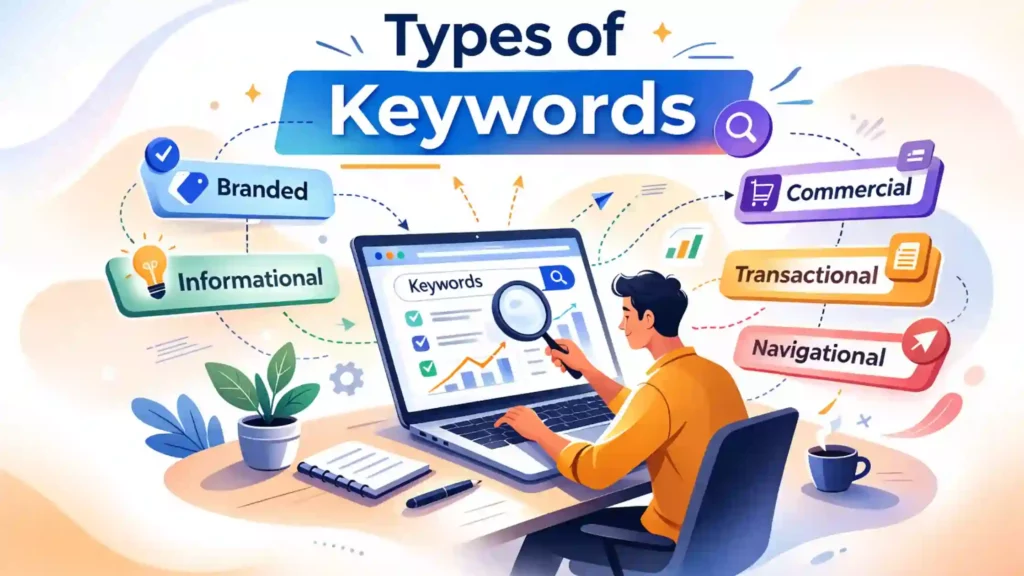
Keywords are words or phrases which people usually search for on search engines. The most primary and by far the important thing to understand about keywords is relevance. Keywords are highly meaningful words which have the ability to explain the basic concepts that an article is trying to talk about. For example, a person might search “How do I know if my egg is hard-boiled”, the keywords for the answer that you are writing will include single terms like “egg”, “hard-boiled” or the phrases “hard-boiled egg”, “know when egg is hard boiled”, “time required to hard-boil” and so forth.
Table of Contents
ToggleChoose the Right Keywords and Know Where to Place Them
Know this that when a person has a question, they want their answers as directly and as quickly as possible. This is why AI overviews have become superbly popular. Now, in order to choose the right keywords you need to be able to identify potential questions. If you are a content writer, here is a process you can follow, it has helped me immensely.
Steps to Choosing the Right Keywords
Step 1: Be clear about what kind of content your website is creating, is it educational, is it for entertainment purposes, is it creative, is it advertisatory. This will determine your tone, your text’s intentions and therefore your language and your keywords.
Step 2: Have a very clear topic in your mind.
Step 3: Place yourself in the shoes of the searcher who is looking up the topic you are writing about and ask yourself how you would want it answered.
Step 4: Create a word cloud of all the important terms and phrases that your answer must contain in order to be relevant. You may take the help of tools like Semrush that offer keyword insights.
Step 5: Make sure that you are not uselessly stuffing your article with keywords. They should appear meaningfully and organically.
Where to Place the Keywords?
Your article should begin with a sentence that most efficiently and concisely answers the most likely question that a searcher has about the topic, which means, your most important keywords should organically appear right at the beginning of your article. Undoubtedly, they should also be present throughout the article, but the beginning is the most strategic position for them.
How to Make Your Content Visible to AI?
Keywords are undoubtedly a very important part of SEO. However care should be taken that they remain relevant and are not placed without context. In the age of AI, such a thing will not fly.
Think about it, whenever you have a specific query, an AI overview gives you a direct answer to the question. The most relevant part is even highlighted.
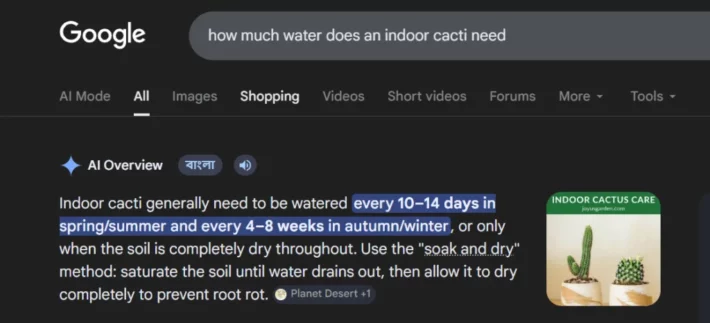
Look how this information is provided by the site “Planet Desert”, well, this should be your aim. To get featured on AI platforms and overviews, they drive incredible amounts of traffic. In order to do that, we need to briefly know about two concepts AEO and GEO
What is AEO?
AEO stands for Answer Engine Optimisation, and refers to the process of optimising your content to directly answer queries that a person may have. In order to do this, you need to write as if you are answering a question. Every segment should be able to stand on its own and make complete sense and definitely they should be aimed at solving a query.
What is GEO?
GEO stands for Generative Engine Optimisation, this refers to the process of optimising your content in such a way that it allows AI to summarise, retrieve and synthesise your content with other contents, to best answer a searcher’s queries.
We shall explore, in detail, how to optimise your content to become more AI friendly, in a blog dedicated to breaking down AEO and GEO.
Types of Keywords Depending Upon Length
Short-Tailed Keywords
These are one word keywords, that are broad in meaning. For instance, “shoes”, “coffee”, it is harder to understand the intention of the searcher when they look up one-word keywords. Most search engines usually filter the results based on the user’s past searches or interests.
Long-Tailed Keywords
These keywords are longer and more specific, they are usually phrases. For example, “best watches for men”, “best eatery near me”, “Google’s privacy policy in 2026” and so on. These keywords express the intentions of the users more clearly.
Types of Keywords Depending Upon the Intention of the User and Tips on Optimising Them
Based on what intention a user has for looking up something on the internet there are four types of keywords, Informational, Navigational, Commercial and Transactional.
Informational Keywords
Informational keywords refer to the queries used by people when they want to learn about something. In most cases, they are unfamiliar with the topic, prior to their search. Eg: “Indian rock bands”, “distance between Delhi and Agra” and so on. A lot of these queries also begin with “wh” questions like How, Where, What, Why.
Google usually shows blogs, guides and informational videos for such queries.
How to Optimise for Informational Keywords?
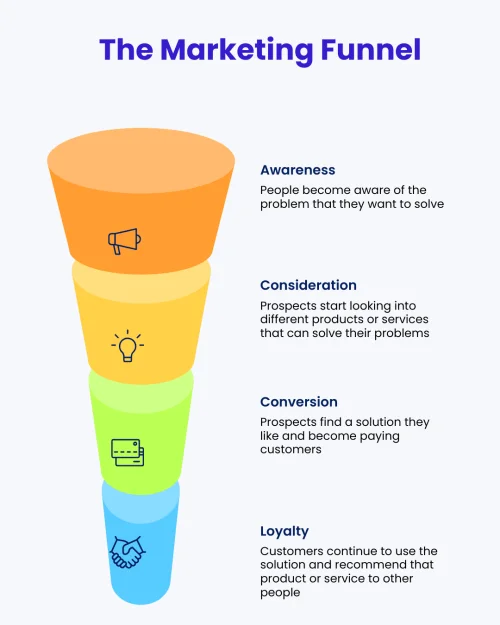
People look up these keywords when they want to gain knowledge, and are least likely to make any purchases. They want a problem solved. This represents the top of the marketing funnel, “awareness”.
The right type of content optimised for Informational Keywords will:
- Be highly informative. This can be done by writing elaborately, accessibly and with conviction.
- Be capable of demonstrating Experience, Expertise, Authoritativeness, and Trustworthiness (E-E-A-T). To do this include the author’s credentials, the page’s accreditations, and write original articles.
- Address frequently asked questions and solve real problems that people raise. Check out the “people also ask” section.
Even if people are least likely to buy at this stage, if you are able to show people that you know the product or service inside out and are prepared to answer any queries they may have regarding what you sell, you may be able to convert them.
Navigational Keywords
Navigational keywords are queries that people make on a search engine in order to be led to a particular website or web page. Eg: “Wikipedia”, “Gyaner Courses”, “Pista House location”.
Such queries show that the searcher is already aware of a brand, product or place and wants to be led to them either physically or on the internet.
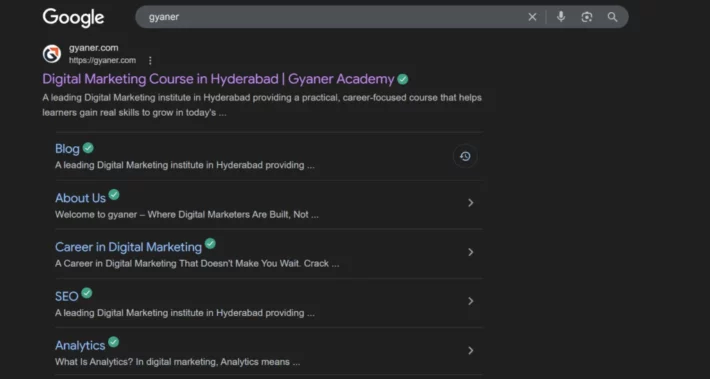
If a site is well known, they should organically rank on top of the first page of Google when a person searches specifically for it. The search result is accompanied with the website’s sitelinks as shown below.
How to Optimise for Navigational Keywords?
This represents the second tier of the marketing funnel, “consideration”. When a person looks up these keywords, they are likely researching about a particular brand and the services and products they offer. When they do look your brand up, you must be ready to show them the following:
- Your brand’s name in the H1 tag, on the homepage.
- An easily navigable site, with clear menus.
- Verification of your business. It is best to create a Google Business Profile.
- The green tickmark on all your pages (as seen above in the picture). This shows potential customers that your site has been screened by Google and is safe to navigate.
Commercial Keywords
Commercial keywords refer to the search queries people make on a search engine when they wish to know about specific products or services. Their intention may be to look at reviews, compare with other products, compare prices. Note that they also look at details like packaging, website design and accessibility to ascertain the reliability of the brand.
Examples: “Cost of Gyaner’s digital marketing course”, “Pista House vs Biriyani House”,
These queries are usually made by people who are planning to make a purchase soon.
How to Optimize for Commercial Keywords?
This represents the third tier of the marketing funnel, “conversion”. When a person looks up such keywords, it can be understood that they will likely buy. Therefore, at this stage you should focus on guiding them towards your brand. This can be done with the following:
- Include detailed descriptions of your products and services
- Add high quality images, you have probably seen how in Amazon you can even view a product in your room. Try creating interactive content such as this.
- Write comparative blogs that highlight your product or service’s benefits over your competitors (without naming them)
- Have a dedicated FAQ section. Remember, the more a person can learn about a product, the higher chance of them buying. Similarly, ambiguities discourage them from patronising you.
Transactional Keywords
Transactional keywords are keywords that people query about when they have a strong intention to buy. Search engines return optimised landing pages that allow the users to immediately make a purchase, when such keywords are looked up.
Example: “buy electric toothbrushes”, “sell old books online”.
How to Optimise for Transactional Keywords?
At this stage, a decision has already been made by the user that a purchase will happen. Make sure that the purchase happens from your website. Here is how you can optimise for Transactional Keywords:
- Make sure that your page immediately directs your potential customer to the page where they can make the transaction.
- The page should be highly navigable and interactive. The correct buttons should be smartly placed, to draw attention.
- Keep the transactional process simple.
- Keep the target keyword as on the title of the page, in the H1 tag.
- To demonstrate trustworthiness, have the reviews available readily and include any certification if you have it.
FAQs
There are four types of keywords relevant in SEO, they are: Informational. Navigational, Commercial and Transactional.
Broader keywords such as “nose pins for men” are usually commercial and more specific keywords like “red 18 litres backpack” tend to be transactional.
Using the right keywords means that your content will show up when a user’s query also contains those words. Keywords most expressly convey the substance of your content to the users, therefore it is extremely important for SEO.
While most keyword research tools are paid, Semrush allows you to look at the intent and search volume of particular keywords for free up to a certain point.
Informational keywords usually begin with a “wh” question like How, What, Where, Why. Navigational keywords include names of particular pages and brands. Commercial keywords are broad searches for specific types of products like “wooden wall clocks” while transactional keywords are more specific “wooden wall clocks by Kaiser”.
